Is the Sale of a YouTube CMS Account Legal? Here Is What YouTube’s Own Policy Says

The Short Answer Is No. But the Long Answer Matters More.

Across social media platforms and creator communities, a specific kind of offer has been circulating with increasing frequency. Someone claims to be selling a YouTube CMS account — complete with Content ID access, original login credentials, linked AdSense, and sometimes even a history of verified revenue. The listing sounds legitimate. The seller presents it as a business transaction. And the buyer, often a creator or small label trying to grow, believes they are getting a shortcut to a powerful tool.

But this is not a shortcut. It is a direct violation of YouTube’s own policies and the consequences fall entirely on the buyer.

What Is a YouTube CMS and Why Does It Matter

YouTube’s Content Management System, commonly referred to as CMS, is not a product you can purchase or subscribe to. It is an enterprise-level platform that YouTube grants, by invitation only, to qualified partners. These include Multi-Channel Networks (MCNs), major music distributors, record labels, and large content rights holders with demonstrated need for rights management at scale.


Through the CMS, approved partners can register music and video assets, use Content ID to claim or monetize user-generated content that includes their work, manage multiple channels from a single dashboard, and control geographic distribution rights. It is a significant operational tool, and YouTube is deliberate about who receives access to it.


The application and approval process exists for a reason. YouTube needs to trust that whoever holds CMS access is operating responsibly, accurately, and in compliance with the platform’s policies at all times.

What YouTube's Policy Actually States

YouTube’s official Content Manager Policies leave no room for ambiguity on this point. The policy explicitly states: do not rent, lease, or sell access to your CMS account. It further specifies that giving unaffiliated or prohibited third parties access to a CMS account, for compensation or any other gain, is strictly forbidden. If YouTube identifies that an unaffiliated party has gained access to a CMS account, the platform reserves the right to take immediate action which includes suspension or permanent termination.

This is not a grey area. It is a named, documented prohibition.

The CMS is granted to a specific legal entity that has entered into a direct agreement with YouTube. That agreement is not transferable. When someone sells a CMS account, they are not selling a product. They are transferring access to a platform relationship that legally belongs to them — and that transfer is not permitted under any circumstances.

Why the Buyer Carries All the Risk

The seller in these transactions typically frames the deal as safe and permanent. They may claim the account is clean, that it has no violations, that the revenue history proves its legitimacy, or that YouTube’s rules somehow permit this kind of sale. None of these claims are accurate.


Once the account changes hands, the original agreement between YouTube and the registered content owner is effectively broken. The buyer is now operating an account that does not belong to them, under credentials that were issued to someone else, and within a legal framework they have no standing in.


If YouTube detects the transfer and it regularly monitors for account behaviour inconsistencies the CMS access will be revoked. Any revenue held in AdSense may be frozen. The channels linked to that account can face penalties. And because the buyer has no legitimate agreement with YouTube, they have no recourse. There is no dispute process. There is no appeal based on having purchased the account. The transaction itself is the violation.

The Pattern in These Listings

A typical CMS account sale listing includes several specific details designed to create the appearance of legitimacy: the year the CMS was applied for and approved, the country of registration, a lifetime revenue figure, and claims that all features are fully operational. The seller may also offer to add the buyer’s bank account to AdSense or assist in transferring the original email credentials.


Each of these elements is a red flag, not a reassurance. Adding a new bank account to an existing AdSense account without YouTube’s knowledge constitutes a form of account manipulation. Transferring original login credentials is explicitly against both YouTube’s and Google’s terms of service. The revenue history belongs to the previous account holder and means nothing once the ownership chain is broken. The seller is not offering a legitimate asset. They are offloading an account with a ticking clock on it.

What Legitimate CMS Access Actually Looks Like

If you are a creator, label, or content rights holder who needs the kind of tools a CMS provides, there is only one compliant path: working with a YouTube-certified MCN or rights management partner that already holds CMS access and has a direct partnership agreement with YouTube.


An MCN like Ping Network operates under a formal agreement with YouTube. When a creator or label partners with us, their content is managed within a compliant, verified framework. There are no credential transfers. No account manipulation. No risk of sudden termination. The rights remain with the actual owner. The tools function as YouTube intends them to. This is not just the safer option. It is the only option that is actually legal.

A Final Word for Anyone Who Has Seen These Listings

If you have come across an offer to buy a YouTube CMS account, the safest action is to not engage. The price may seem reasonable. The revenue history may seem impressive. The seller may seem confident. But the moment you take ownership of that account, you are operating in violation of YouTube’s policies, with no legal protection and no recourse if the access is revoked. The right question is not whether the account looks legitimate. The right question is whether your relationship with YouTube is legitimate. One can only be built properly, through the right channels.

At Ping Network, we work with creators and rights holders who want to grow on YouTube the right way — with full compliance, transparent agreements, and tools that actually belong to them.

How to Turn Viral Views into Revenue in 2026 (Smart Creator Strategy Guide)

Why Trending Moments and News Spikes Drive YouTube Growth

Every time there is uncertainty, whether it is economic pressure, lifestyle disruption, or even rumours of something like a lockdown, audience behaviour shifts almost immediately. People start searching more. Not casually, but with intent.
They look for solutions, alternatives, quick fixes, and ways to adapt. This leads to a sudden spike in search-driven content consumption. At the same time, social platforms get flooded with creators reacting to the moment some with useful content, many with surface-level participation. This creates a very specific environment.

There is a surge in demand, but also a rapid increase in content supply. New creators enter, existing creators pivot, and timelines become saturated with similar themes. For a brief period, visibility becomes easier, reach expands, and even average content can get traction.

But this phase is temporary. What looks like growth is often just attention concentration around a moment. And once that moment stabilises, the same content that performed well can quickly lose relevance.

What Happens to YouTube Channels During Sudden Traffic Spikes

From a platform perspective, these moments are highly predictable. Search queries increase around specific topics. Recommendation systems test more content within those themes. New viewers enter the ecosystem, often discovering creators for the first time. For many channels, this shows up as a spike in impressions, views, and new audience. But there are two parallel shifts happening. First, content becomes highly repetitive. When too many creators respond to the same trend without adding depth, differentiation drops. The platform then becomes more selective, pushing only the content that performs better in terms of retention and satisfaction.
Second, audience behaviour becomes short-term. Viewers are not necessarily loyal they are problem-driven. They come for a specific answer or moment and leave once that need is fulfilled. This is why many creators experience a spike followed by a sharp drop. They mistake momentary discovery for sustained growth.

Why Most Creators Fail to Convert Viral Views into Subscribers

The common response to such spikes is to create more of the same content that is currently working. While this may extend the visibility window slightly, it rarely builds long-term value. Because once the underlying trigger fades, so does the relevance of that content. Another major gap is the absence of a conversion strategy.


Creators gain new viewers during these periods, but they do not give those viewers a reason to stay. There is no clear positioning, no content continuity, and no deeper layer of value beyond the immediate topic. As a result, traffic increases but audience retention does not. And without retention, growth resets.

How to Use Trending Topics to Grow Your YouTube Channel

The difference between reactive creators and strategic creators lies in how they approach the same situation. Instead of chasing trends at a surface level, smart creators align with underlying audience behaviour. For example, during conversations around rising fuel costs or supply concerns, the real shift is not just “news”—it is a change in how people think about daily life. Cooking methods, cost-saving habits, home efficiency, and alternatives become more relevant. Creators who understand this do not just react—they translate the moment into practical content. They create around:

  • Alternatives (e.g., induction cooking, low-cost meals)
  • Adjustments (e.g., saving techniques, resource optimisation)
  • Everyday problem-solving aligned with the situation

This is often referred to as “topic hijacking,” but at its core, it is simply contextual relevance done right. The goal is not to participate in the moment. The goal is to extract value from the behaviour shift it creates.

How to Turn New Viewers into a Returning Audience on YouTube

One of the most overlooked aspects of these spikes is what happens after discovery When new viewers come in, they are not yet loyal. They are evaluating. If the next piece of content they see feels disconnected, inconsistent, or irrelevant, they leave. But if there is a clear content direction, they are more likely to stay and explore further. This is where continuity matters. A creator needs to think beyond a single video and ask:
“If someone discovers me today, what do they see next?”

This is how conversion happens. It is not through one viral video, but through a series of connected content experiences that reinforce value and build trust. Without this, even high-performing videos remain isolated wins.

Shorts vs Longform Strategy: How to Convert Reach into Watch Time

During attention spikes, reach is easier to achieve but depth is harder to build. Short-form content plays a strong role in capturing this increased attention. It allows creators to enter the discovery layer quickly and frequently. But discovery alone does not build a relationship.


Long-form content is where depth is created. It is where a viewer spends more time, understands the creator better, and begins to trust the content. This is also where monetisation potential becomes stronger, as watch time, engagement, and content depth improve. Creators who use Shorts to capture attention and long-form to retain it are able to convert momentary spikes into something more stable. Without this balance, growth remains shallow.

Why YouTube Views Don’t Always Generate Revenue

One of the most common frustrations during these moments is this:
views go up, but earnings do not follow proportionately. This happens because monetisation is not directly linked to views—it is linked to systems.If a creator’s AdSense setup is incomplete, payments can be delayed regardless of earnings. If the niche is not advertiser-friendly or clearly defined, revenue potential remains inconsistent. If there is no content funnel, viewers come and leave without contributing to long-term value. In many cases, creators focus heavily on gaining attention but neglect the structure needed to monetise it. Revenue is not built on spikes. It is built on consistency, clarity, and proper setup.

How to Monetise YouTube Traffic with the Right Systems

The real opportunity during these phases is not just traffic—it is learning. Creators who step back and analyse what worked, why it worked, and how it can be repeated beyond the moment are the ones who build long-term growth.
This includes:

  • Understanding which topics drove intent-based traffic
  • Identifying what held viewer attention
  • Building a repeatable content direction from those insights

Over time, this becomes a system. A system where content is not dependent on external events, but capable of performing consistently regardless of them.

Final Takeaway: Viral Moments vs Long-Term YouTube Growth

Moments like these will come and go. They will bring spikes in attention, temporary visibility, and short-term growth opportunities. But they do not guarantee sustainability. What determines long-term success is what a creator does with that spike. Do they treat it as a one-time gain? Or do they use it to build a structured, repeatable growth system? Because in 2026, the difference is clear. Moments bring traffic. Systems build careers.

How Ping Helps Creators Turn Views into Sustainable Growth

As the best MCN in India, we at Ping Network help creators move beyond reactive content and build structured growth systems from content strategy to monetisation readiness. If you’re seeing spikes in your channel and want to convert them into long-term growth, the right approach can make all the difference.

0 to 1 on YouTube in 2026: A Practical Beginner Playbook That Works

Thinking of Starting YouTube? Why 2026 Is Different from the Lockdown Growth Phase

There has been a lot of conversation lately around a possible lockdown. While it remains a rumour, the behavioural pattern it has triggered is very real. Social media is already filled with relatable reels of people joking about finally becoming content creators and not missing this “opportunity.” We have seen this before. During COVID, a large number of underdog creators found visibility and built strong audiences. That phase created a perception that when life slows down, content creation becomes an easy entry point to growth.


But the context in 2026 is very different. Today, even if you get time, starting is not the advantage it once was. The advantage lies in how you start, how fast you learn, and how well you adapt. Because, unlike 2020, the ecosystem is no longer forgiving. It is structured, competitive, and performance-driven from day one. So if this moment pushes you to begin, the approach has to be deliberate—not reactive.

How to Choose the Right Niche in 2026 (Search Demand vs Passion)

Most beginners believe that choosing a niche is about following passion.In reality, niche selection is about positioning yourself in an existing demand system. Passion helps you sustain effort, but it does not automatically create viewership. Viewership comes from alignment with what people are already searching for, struggling with, or consuming repeatedly. This is why the most effective starting point is not “What do I like?” but: “Where does my capability intersect with existing audience demand?”
Search behaviour is one of the clearest indicators of this demand. It reflects what people are actively trying to solve or learn. When a creator aligns with this, they are not pushing content into the system—they are entering conversations that already exist.


At the same time, capability matters equally. A niche that has demand but cannot be consistently executed becomes unsustainable. The goal is not to pick something trendy, but something repeatable. For example, a creator who chooses “quick, practical home cooking” has far more content depth and frequency potential than someone starting broadly with “food videos.” The difference is not creativity—it is clarity. This clarity at the beginning reduces confusion later.

Your First 10 YouTube Videos Strategy (What Beginners Should Post First)

One of the biggest mistakes new creators make is treating their early videos as final output. In reality, your first 10 videos are not about performance. They are about understanding how the platform and audience respond to you. Most creators either overthink these videos or treat them casually. Both approaches slow down growth. What works better is treating these uploads as a structured learning phase. When you create content around search-driven topics, you start understanding how discoverability works. You see what kind of queries bring people in, how your content ranks, and whether your topic selection aligns with actual demand. When you create content around current conversations or trends, you learn something different—how timing, relatability, and packaging influence performance. You begin to understand what makes someone stop scrolling and engage.

This combination gives you a much clearer picture of:

  • Why someone clicked
  • Why they stayed (or didn’t)
  • And what made the content worth watching

Without this phase, creators operate on assumptions. With this phase, creators start operating on signals. And in 2026, growth comes from reading signals correctly.

Do You Need Expensive Equipment to Start YouTube? (What Actually Matters)

A common delay in starting comes from the belief that better equipment leads to better results. This is one of the most persistent myths in content creation Production quality does matter, but not at the starting stage. What matters more is whether the viewer immediately understands what they are getting from your content, and whether it is delivered clearly.


A basic phone is sufficient to begin. Clear audio ensures the message is understood. Simple lighting and framing ensure the content is watchable. Beyond that, the marginal gain from better equipment is far lower than the gain from better clarity.  In fact, many creators with strong setups struggle because the content itself lacks direction or structure. Early growth is not limited by production. It is limited by communication and relevance. The faster a creator realises this, the faster they start improving what actually matters.

Common Beginner Mistakes on YouTube That Slow Growth

Starting is rarely the hardest part. Continuation is. The first major slowdown comes from overthinking. Many creators delay publishing because they want every video to be perfect. But perfection is not a starting requirement—it is a byproduct of iteration. Without publishing, there is no feedback loop. Without feedback, there is no improvement.


The second major gap is underestimating packaging. Titles and thumbnails are often treated as an afterthought, when in reality they determine whether the content gets a chance at all. A well-made video that is poorly presented struggles to get clicks. And without clicks, the system has no reason to test or push the content further. These are not advanced growth tactics. They are foundational. Ignoring them creates friction. Fixing them creates momentum.

How Successful Creators Think: Learning Faster vs Posting More

The biggest advantage a new creator has today is not creativity or resources—it is adaptability. Every upload provides feedback. Where viewers drop off, what they respond to, what drives clicks, and what holds attention. These are not just metrics—they are signals that guide improvement. The creators who grow fastest are not the ones who get everything right initially. They are the ones who learn faster than others. This requires a shift in mindset. Instead of asking, “Did this video perform?”, the better question is: “What did this video teach me?”


Over time, these learnings compound. Content improves. Decisions become sharper. Growth becomes more predictable. This is what separates random effort from structured progress.

Final Takeaway: How to Grow on YouTube in 2026

Whether a lockdown happens or not is secondary. What matters is that moments like these often push people to finally start. But starting in 2026 is not about catching an opportunity—it is about building a process. If you do get the time and intent to begin, your advantage will not come from timing. It will come from how quickly you move from confusion to clarity. Start without overthinking. Learn from every upload. Refine continuously. Because today, growth is not given to creators who start early. It is built by creators who learn and adapt consistently.

How Ping Helps New Creators Grow Faster

As the best MCN in India, We at Ping  Network, work with creators at the 0–1 stage to remove guesswork and bring clarity to what actually works. From identifying the right content direction to structuring videos around audience intent and retention, the focus is on building a system, not just posting content.


If you’re starting your journey or trying to get initial traction, the right guidance early on can significantly reduce trial and error and accelerate your growth. Explore more insights on our website or connect with us to start building your channel the right way.

From Lockdown Trends to 2026 Reality: What Actually Makes a Creator Grow Today

The Myth That Still Shapes How People See Creator Growth

There is a reason so many people still look back at the lockdown period and think, ” That was the best time to become a creator. It is not just nostalgia. During COVID, a large number of underdog creators found visibility, built communities, and in many cases turned content creation into a real profession. Even today, that phase is remembered as a golden window when ordinary people picked up a phone, started posting, and suddenly found an audience. But that memory has also created a dangerous myth. The myth is that if another uncertain or stay-at-home phase appears, creator growth will once again become easy. Simply showing up during a moment of disruption is enough to break through. That the market will somehow make space for everyone who starts creating. In 2026, that assumption is not just outdated, it is misleading.

The reality is that the creator economy has changed fundamentally. Growth still happens, new creators still emerge, and underdogs can absolutely win. But the way growth happens today is very different from how it happened during lockdown. Back then, timing gave creators an unusual advantage. Today, growth is far more structured, competitive, and system-driven. It is no longer accidental. It is engineered. To understand what makes a creator grow now, it is important to first understand why so many creators grew then.

Why So Many Creators Grew During COVID

During COVID, audience behaviour shifted at scale. People were at home, screen time increased dramatically, and digital content became a primary source of entertainment, information, comfort, and routine. Viewers were not just consuming more content; they were consuming it more openly. They had more time to explore new formats, discover unfamiliar creators, and spend longer periods on platforms. This naturally created more opportunities for emerging voices to get noticed. At the same time, content supply had not yet reached the kind of saturation we see today. Yes, many people began posting during lockdown, but the overall ecosystem was still less crowded than it is now. Platform habits were evolving quickly, audiences were more forgiving, and creators could grow even while learning publicly. In many categories, consistency and relatability alone were enough to build traction. That does not mean creators who grew during that period did not work hard. Many of them did. But it does mean they were operating in an environment where the gap between audience demand and content supply was unusually favourable. More people were watching, fewer creators were fully optimised, and platforms were aggressively surfacing content to keep users engaged. That environment does not exist in the same way anymore.

Why the Old Playbook Does Not Work in 2026

In 2026, platforms are far more mature. Recommendation systems are more refined, audience expectations are sharper, and nearly every niche has become more crowded. Today, a creator is not only competing with others in the same category, but also with a massive volume of professionally packaged, strategically planned, and algorithm-aware content. Posting alone is no longer a differentiator. Presence is common. Precision is rare.


This is where many people misread the present through the lens of the past. They assume that if people begin spending more time online again, the same formula will repeat itself. But increased screen time alone does not guarantee opportunity. If anything, it raises the quality bar. Platforms now have more data, more creators to choose from, and better systems for identifying which content deserves distribution. The algorithm has become less about giving everyone a chance and more about rewarding content that proves it can hold attention, satisfy intent, and keep users within the platform ecosystem. That is why the old playbook of random posting, trend copying, or waiting for virality is much weaker today.

What Actually Works On YouTube In 2026

The first major shift is that content must be rooted in audience intent. This is one of the clearest differences between creator growth in the lockdown era and creator growth in 2026. Earlier, a creator could sometimes gain momentum through personality-led, spontaneous, or loosely structured content because people were in a discovery mode. Today, much of growth begins when a creator understands what the audience is actively looking for, feeling, or struggling with. Intent-based content performs because it meets people where they already are. It answers a question, solves a problem, simplifies a decision, or responds to a real behaviour pattern. In practical terms, that means creators need to stop asking only, “What do I want to post?” and start asking, “Why would someone choose to watch this right now?”


This applies across niches. A food creator may see stronger performance by aligning recipes with actual household concerns, such as budget cooking, quick meals, storage, or appliance-based alternatives. A finance creator may grow faster by addressing urgent money behaviours rather than speaking in broad motivational language. A lifestyle creator may perform better by tapping into routines, anxiety points, or seasonal shifts instead of posting generic inspiration. The common thread is relevance. Random content can still get views. But relevance builds repeatability.

Why Retention-First Storytelling Matters On YouTube

The second major shift is that growth today depends heavily on retention-first storytelling. Many creators still believe that success comes from posting frequently enough, but frequency without watchability does not create sustainable growth. A creator may get an impression, maybe even a click, but if the content does not hold attention, the system has little reason to keep recommending it.


This is why storytelling has become a performance factor, not just a creative one. Retention-first storytelling means understanding that every video is a journey. The title and thumbnail create expectation. The opening seconds must justify the click. The middle must keep delivering value without losing momentum. The ending should leave the viewer satisfied, curious, or motivated to continue with more content. This is not limited to cinematic creators or polished productions. Even a simple talking-head video needs structure. Even an educational video needs pacing. Even a recipe needs narrative movement. Viewers do not stay because a creator uploaded. They stay because the creator gave them a reason to.


That reason could be suspense, clarity, transformation, emotional connection, or practical usefulness. But it must exist. In 2026, content that gets recommended is content that consistently proves it can maintain viewer interest. This is why creators who focus only on posting more often without improving their storytelling often feel stuck. They are working harder, but not becoming more watchable.

Why Multi-Format Strategy Has Become Essential In 2026

The third major shift is format strategy. During lockdown, a creator could sometimes build meaningful traction through a single format because audience habits were less fragmented and platform behaviour was different. In 2026, format matters not just for content delivery, but for audience funnelling.


A smart creator today understands the role of different content types. Shorts can create reach, fast discovery, and high-frequency touchpoints. Longform builds depth, trust, stronger watch time, and a deeper audience relationship. Community interaction and ecosystem thinking help maintain continuity between uploads. None of these formats should be seen in isolation.


One of the biggest mistakes creators make is treating Shorts and longform as separate identities. In reality, the strongest growth often comes when they support each other. A Short can introduce a creator to a new viewer. A longform video can convert that curiosity into trust. A consistent content ecosystem can then turn that viewer into a returning audience member. That is where growth becomes more stable. The keyword here is synergy. Shorts without longform depth can create shallow visibility. Longform without discoverability can limit reach.


Random experimentation without a format strategy creates scattered results. The creators who grow today are usually not those doing the most, but those connecting each format to a clear purpose.

Why “Just Start Posting” Is No Longer Enough

This is also why the phrase “just start posting” is incomplete advice in 2026. Starting matters, yes. But growth does not come merely from participation. It comes from building a content system that works. A system where topics are chosen with audience intent in mind. A system where videos are structured to retain attention. A system where formats are used strategically instead of casually.

And most importantly, a system where every upload teaches the creator something measurable. This is the real difference between then and now. In the lockdown era, many creators benefited from an open field. In 2026, creators must create their own advantage. That advantage comes from understanding behaviour better than others, packaging content more effectively than others, and staying consistent with purpose rather than noise.

The Real Takeaway

None of this should discourage new creators. In fact, it should do the opposite. Because if growth were still based mostly on luck, timing, or easy virality, then long-term success would be far less controllable. The good news is that growth today is more demanding, but it is also more learnable. A creator who understands strategy has a much better chance of building something durable than one who simply waits for the perfect moment.


That is the real takeaway. Lockdown may have made creation feel accessible. But 2026 demands intention. The creators who will grow now are not necessarily the loudest, earliest, or most frequent. They are the ones who understand that modern growth is built through relevance, retention, and format intelligence.


The era of accidental creator success is fading. The era of engineered creator growth is already here.

How Ping Network Helps Creators

At Ping Network, this is exactly where we help creators and channels think better, not just post more. From content direction to platform-aware growth strategy, the goal is to build systems that last beyond momentary spikes. Because in 2026, staying relevant is not about chasing opportunity.


It is about knowing how to convert it into sustainable growth.

All About Public Domain, Fair Use & Copyright

One of the biggest misconceptions in the creator ecosystem is this:
“If it’s available online, I can use it.”
This assumption is the root cause of most copyright claims, demonetisation issues, and even channel strikes. The reality is more structured. Every piece of content, music, video clips, images, and film footage exists under a specific legal status. And unless you understand that status clearly, you’re always at risk of using something you don’t actually have the right to use. Three terms come up repeatedly in this context: copyright, public domain, and fair use. They are often used interchangeably, but they mean very different things and confusing them can cost you your monetisation.

Copyright: The Default Rule

By default, almost everything you see online is protected by copyright. The moment a piece of content is created, whether it’s a song, a film clip, a podcast, or even a short video, it automatically belongs to its creator or rights holder. This means no one else can reuse, upload, or monetise it without permission. On YouTube, this system is enforced through Content ID and manual claims. If you upload copyrighted material without the rights, the platform can:

  • Claim your video and redirect revenue
  • Restrict visibility or block it in certain countries
  • Issue a strike in more serious cases

What’s important to understand is that crediting the original creator does not give you permission. Neither does adding a disclaimer. Copyright is not about intent; it’s about ownership.

Public Domain: What You Can Freely Use

Public domain content is the safest category for creators.
When a work enters the public domain, it means it is no longer protected by copyright. This usually happens after a certain number of years (depending on the country) or when the creator explicitly releases it for public use. This allows you to:

  • Use the content freely
  • Modify or edit it
  • Monetise it without permission

However, the challenge is not access it’s accuracy. Just because something looks old or widely available does not mean it is in the public domain. Many creators assume that vintage clips, old songs, or historical footage are free to use, but that is not always true. Different countries have different copyright durations, and some works remain protected much longer than expected. Another common mistake is confusing “royalty-free” with public domain. Royalty-free content still comes with a license you are allowed to use it under certain conditions, but you don’t own it. Public domain, on the other hand, has no such restrictions.

Fair Use: The Most Misunderstood Concept

Fair use is where most creators get into trouble. It is often treated as a loophole, something that allows you to use copyrighted material as long as you add commentary or make slight changes. But fair use is not a rule you can claim. It is a legal defence that is evaluated case by case. On YouTube, fair use generally applies when the content is transformative—meaning you are adding significant value, not just reusing the original. Examples where fair use may apply:

  • Commentary or criticism
  • Educational breakdowns
  • Reviews or analysis
  • Parody

But even in these cases, there is no guarantee. Using a full movie scene with minimal commentary, or repurposing someone else’s content with light edits, is unlikely to qualify. The more your content depends on the original material, the weaker your fair use position becomes. Another key point: YouTube’s systems do not “approve” fair use automatically. Content ID can still claim your video. At that stage, you can dispute the claim but the final decision may involve the rights holder, and in some cases, legal escalation. So while fair use exists, it is not a safe strategy for consistent monetisation.

Where Creators Go Wrong

Most copyright issues don’t come from intentional misuse; they come from misunderstanding. Creators assume that adding voiceover, trimming clips, or changing background music is enough to make content original. Others believe that if a video is already available on YouTube, it must be reusable. Some rely heavily on fair use without fully understanding how subjective it is. Others use “free” content from the internet without verifying whether it is truly in the public domain or simply licensed under specific terms. The problem is not creativity, it is clarity. And on a platform like YouTube, where monetisation depends on compliance, this lack of clarity directly affects revenue.

Best Long-Term Monetisation Strategy

If your goal is to build a stable, monetised channel, the safest approach is simple: own or properly license what you use.
This could mean:

  • Creating original content
  • Using assets with clear commercial licenses
  • Working with partners who manage rights and permissions

Public domain content can be a strong resource if verified correctly. Fair use can work in specific formats like commentary or education, but it should not be treated as a default strategy. Because at scale, unpredictability becomes risk.

Conclusion

Copyright is not just a legal framework; it is the foundation of how YouTube’s ecosystem functions. Every view, every ad, and every payout is tied to ownership. Creators who understand this build channels that are not only creative but also secure and monetisable. Those who don’t often find themselves dealing with claims, blocked videos, or lost revenue sometimes after investing significant time and effort. The difference is not talent. It is understanding what you truly have the right to use.

Want Experts To Manage Your Content Safety?

Copyright issues don’t just affect your videos; they affect your revenue, your reach, and your long-term channel stability. At Ping, we help creators navigate content rights, resolve claims, and set up systems that protect both their content and their earnings. If you’re using third-party content or planning to scale your channel, getting this right early makes all the difference. Explore Ping Network to build a copyright-safe and monetisation-ready YouTube strategy.

AdSense Mistakes That Delay or Block Your YouTube Payments

For most creators, monetisation feels like a clear milestone. You get approved for the YouTube Partner Program, revenue starts appearing in your dashboard, and it feels like the system is finally working in your favour. But for a surprising number of creators, the first real problem begins after that. The money shows up in YouTube Studio, but it doesn’t reach the bank account. Days pass, then weeks, and confusion builds. The assumption is usually that YouTube is slow or that something technical has gone wrong. In reality, the issue almost always sits within AdSense.

The System Most Creators Don’t Fully Understand

YouTube and AdSense work together, but they serve very different roles.YouTube tracks performance views, watch time, RPM, and estimated revenue. But it does not handle payouts. The moment your earnings are generated, they enter AdSense’s system, which treats them like financial transactions rather than content metrics. This distinction is important.


What you see in YouTube Studio is not “ready to withdraw money.” It is estimated revenue that still needs to be validated, finalised, and cleared through AdSense’s payment infrastructure. Until that process is complete, the money is technically not eligible to be paid out. This is where many creators misread the situation. Everything looks normal on YouTube, so they assume everything must be fine. But AdSense operates in the background, and if something is incomplete or incorrect, it simply pauses progress rather than surfacing a clear error.

How Small Setup Errors Turn Into Big Payment Delays

AdSense is not forgiving when it comes to identity and account accuracy. It is built to comply with global financial regulations, which means every detail you enter becomes part of a verified identity. If your name in AdSense doesn’t match your bank account exactly, the system doesn’t interpret it as a minor typo it treats it as a mismatch between identities. If your country is incorrect, it affects how your account is classified for payments and taxes. If you accidentally create more than one AdSense account, the system flags it as a violation, not a workaround. What makes this challenging is timing. These errors don’t stop you from earning revenue. Your videos will still monetise, ads will still run, and your dashboard will continue to show income. The problem only becomes visible when AdSense tries to release that income. By then, the mistake is already embedded in the system.

The Verification Layer: Where Most Accounts Get Stuck

AdSense operates on a principle that is very different from most creator tools—it does not release payments until it fully trusts the account. That trust is built through verification. One of the most critical steps is address verification through a PIN. Google physically mails this PIN to your registered address. This is not just a formality, it is a way to confirm that the account belongs to a real, reachable individual. If the address is incorrect, outdated, or the PIN is not entered, the system will continue holding payments regardless of how much you earn. Then comes identity verification. This step requires you to submit official documents, and the expectation is strict consistency. Your AdSense name, your bank account name, and your government ID should align without variation. Even small differences like missing initials, spelling inconsistencies, or swapped name formats can create friction.

Tax information is another area where creators often underestimate the impact. Because YouTube revenue can involve international payment flows, AdSense requires tax details to determine how payments should be processed. If this is not completed, the system doesn’t partially proceed it simply waits. All of these steps operate silently. There is no constant reminder or alert system pushing you to complete them. So it’s possible to have a monetised channel earning consistently, while the payment pipeline remains incomplete.

Why “Fixing It Quickly” Often Makes It Worse

When creators realise payments are delayed, the instinct is to take immediate action. This usually involves creating a new AdSense account, trying to relink accounts, or changing details rapidly in an attempt to resolve the issue. But AdSense is not designed for frequent structural changes. It values consistency over correction.


Creating multiple accounts, even unintentionally, can trigger policy flags. Switching accounts mid-way can disconnect your earnings history from your payment profile. Editing core details repeatedly can slow down verification rather than speed it up. What feels like a quick fix from a creator’s perspective often appears as instability from the system’s perspective. And in financial systems, instability leads to caution, which means more delays, not fewer.

The Payment Timeline: Structured, Not Instant

Another layer of confusion comes from expectations around timing. AdSense does not operate in real-time. Revenue goes through a monthly cycle. It is first calculated and adjusted, then finalised, and only after that is it scheduled for payment. On top of this, payments are only triggered once your earnings cross the minimum threshold. So even in a perfectly set-up account, there is a natural delay built into the system. Now, if you combine this structured timeline with incomplete verification or incorrect details, the delay starts to feel unpredictable. But in reality, it is simply the system waiting for two things to align: time and compliance.

What Actually Solves the AdSense Problem

There is no shortcut or hack to make AdSense payments faster. The only reliable solution is correctness. A single, properly set up AdSense account. Accurate personal details that match across all documents. Completed verification at every level. Stable linkage to your YouTube channel. Correct bank information. Once these are in place, the system does not need intervention. Payments start moving as per schedule, without surprises or interruptions.


The difference is not speed; it is smoothness.

Conclusion

Creators spend a lot of time thinking about growth, better content, stronger thumbnails, higher CTR, and improved retention. All of that is important. But monetisation is not just about earning. It is about receiving. AdSense sits quietly in the background, but it controls the most critical part of the creator journey, the actual payout. And unlike content, where experimentation is encouraged, this system demands precision. When that precision is in place, payments feel automatic. When it’s not, even a well-performing channel can feel like it’s stuck earning revenue that never quite arrives. Earning on YouTube but not getting paid is more common than you think—and in most cases, the problem isn’t your content, it’s your AdSense setup.


At Ping, we work closely with creators to fix exactly these gaps from incorrect account setups and verification issues to monetisation bottlenecks that quietly delay payments. If your revenue is stuck, delayed, or inconsistent, it’s usually a fixable problem. You just need to know where to look. Get your monetisation system right, not just your content. Visit Ping Network to streamline your YouTube earnings and ensure you actually receive what you’ve earned.

How We Turned a Real-World LPG Concern into a High-Performing YouTube Video

In the creator economy, timing is often spoken about, but rarely executed well. Most content either reacts too late or follows trends without understanding the underlying audience behaviour. What often gets missed is that real-world events do not just create conversations they reshape search intent.During a recent phase of geopolitical tension and discussions around fuel supply, India saw a noticeable rise in conversations around LPG availability and rising costs. For households, this was a practical concern. For creators, it presented a moment of behavioural shift.

At Ping Network, we viewed this not as a “trend” to participate in, but as a shift in what the audience was actively trying to solve.

Understanding the Behaviour Shift

Traditionally, food content on YouTube is driven by discovery and inspiration — recipes, techniques, and presentation formats. However, during this period, user behaviour moved away from passive consumption towards active problem-solving

People were no longer asking, “What should I cook today?
They were asking, “How do I cook if LPG becomes expensive or unavailable?

This led to a spike in searches around induction cooking, how it works, whether it is viable for Indian households, how it compares to gas cooking, and what the cost implications look like. More importantly, this shift was clearly reflected in keyword patterns. Queries became more specific, intent-driven, and solution-oriented, indicating that users were actively researching before making decisions. This distinction was critical. The opportunity was not in creating more food content, but in creating contextual utility content supported by strong search intent.

Strategic Shift: From Content Calendar to Contextual Content

Instead of continuing with our planned recipe-led content, we made a deliberate decision to pivot. The idea was simple: create a video that directly addresses the emerging concern while still staying within our broader content ecosystem.

We chose to focus on induction cooking not as a product showcase, but as a practical guide. The video was structured to answer real user questions: how induction cooktops work, what types are available, how they can be used in Indian kitchens, and how they compare to traditional LPG cooking in everyday scenarios. Alongside content direction, keyword strategy played a crucial role in shaping discoverability. We mapped high-intent queries such as “induction vs gas cooking,” “induction cooktop usage,” and “electricity vs LPG cost” into the title, description, and supporting metadata.

This ensured that the video was not just relevant in the moment but also positioned to capture ongoing search demand. Equally important was timing. The video was published when curiosity around the topic was rising, ensuring that it aligned with peak user intent rather than trailing behind it.

Execution: Simplicity, Clarity, and Relevance

The success of the video did not come from high production complexity or experimentation with format. It came from executing the basics with precision. The narrative was built around a clear problem-solution structure. The language was kept simple to ensure accessibility across a wide audience base. Instead of overloading the video with technical details, the focus remained on practical usage and everyday applicability.
At the same time, packaging decisions were made with search and click behaviour in mind. The title was aligned with high-intent keywords, while the thumbnail communicated immediate value, reinforcing the problem the viewer was trying to solve.In essence, the content did not try to impress; it aimed to assist, while remaining highly discoverable.

Outcome: When Intent Drives Distribution

The result was one of the strongest performances on the channel in the past year. The video saw significant traction through search, supported by strong engagement signals that allowed it to expand into suggested feeds.
What stood out was not just the scale of performance, but the consistency of discovery. The video continued to attract viewers beyond the initial spike, indicating that it successfully bridged the gap between topical relevance and evergreen utility.
This reinforces an important principle: when content aligns closely with both user intent and keyword demand, distribution becomes a natural outcome rather than a forced effort.

Key Learning: Beyond Trends, Towards Behaviour

One of the biggest misconceptions in content strategy is equating trends with opportunity. In reality, trends are often just surface-level indicators. The real opportunity lies in understanding the behaviour driving those trends and pairing that insight with the right search strategy. In this case, the geopolitical situation created awareness, but the real shift was in household decision-making. People were evaluating alternatives, comparing costs, and looking for practical solutions.
By aligning content with that decision-making process and reinforcing it with the right keywords we were able to create something that was both timely and sustainably discoverable.This is where many creators miss out. Content is often created around a trend, rather than for the user navigating that situation.

Conclusion

This case highlights a simple but powerful idea the most effective content is not always driven by creativity alone, but by context and discoverability. For creators and teams operating in a highly competitive ecosystem like YouTube, the ability to observe real-world signals, align with search behaviour, and translate that into relevant content can significantly impact performance.
The next high-performing video may not come from chasing what is trending, but from identifying what your audience is actively trying to figure out and ensuring your content is built to be found when they search for it.

How Ping Network Approaches Content Opportunities

At Ping Network, our approach to content goes beyond calendars and formats. We focus on identifying shifts in audience behaviour and translating them into actionable content strategies that drive both reach and long-term value. Whether it is leveraging real-world events, improving discoverability through search-led content, or building sustainable growth through consistency and positioning, our focus remains on helping creators and brands stay relevant in a constantly evolving ecosystem.

If you are looking to optimise your YouTube strategy, strengthen content performance, or explore new growth opportunities, explore more insights at PingNetwork.in or connect with us to understand how we can support your channel’s growth.

Key Do’s and Don’ts To Cover War Content on YouTube

Whenever a war or geopolitical conflict takes place, the Internet quickly becomes the main source where people look for updates, explanations, and opinions. Mainly on YouTube, News channels, commentary creators, educators, and even entertainment creators start covering the topic to help audiences understand what is happening.

As global tensions rise, searches for war news today, world war 3, world war 3 news, current war situation, and latest war news have surged across India. Many people are also trying to understand the situation through queries, such as ” war explained, geopolitical conflict explained, what caused the war, and why the war is happening, while others are closely following updates such as Russia-Ukraine war news, Israel-Palestine war updates, and other global conflict news.

Alongside these developments, concerns about the impact of war on India, including oil shortage, LPG gas shortage, fuel supply issues, and rising petrol and diesel prices, have also started trending in searches. As a result, many YouTube creators are producing videos covering war updates, military analysis, and the economic impact of global conflicts. However, while creating such content, while such content can attract high public interest and reach, it also falls under several sensitive policy areas on YouTube, including violence guidelines, misinformation policies, and advertiser-friendly content rules. If creators are not aware and careful, their videos may face demonetization, removal, strikes, or even channel suspension.

For creators who are covering war-related topics, understanding the right approach to producing responsible content is essential. Below are some key dos and don’ts that can help creators stay compliant with YouTube policies.

Focus on Informational and Educational Content

YouTube generally allows war-related videos when they are presented in an educational, documentary, or analytical context. The platform encourages content that helps viewers understand the situation rather than content that sensationalises it. Creators can safely focus on topics such as:

  • Explaining the background of the conflict
  • Discussing geopolitical or historical context
  • Breaking down military strategies or developments
  • Providing balanced commentary or analysis

The overall tone should remain informative and responsible, avoiding dramatic or emotionally charged storytelling that may appear exploitative.

Use Verified Sources and Avoid Misinformation

During conflicts, information spreads extremely fast, and many claims circulating online may not be verified. Creators must be careful not to unintentionally spread misinformation. Whenever possible, rely on credible and recognised sources such as established news organisations, official statements, and verified reports. If discussing developing situations, it is always better to clarify that the information may still evolve rather than presenting speculation as a confirmed fact. Taking this approach helps creators stay within YouTube’s misleading information policies, which are often enforced more strictly during major global events.

Be Careful While Using War Footage

Some creators use war footage or visuals to explain events. While this can help provide context, it must be handled carefully because graphic content can violate YouTube’s violence policies. If visuals from the conflict are used, creators should ensure that:

  • The footage is necessary for explaining the topic
  • Graphic details are blurred or edited where possible
  • The visuals are accompanied by commentary or explanation

When used responsibly, such footage can support educational or documentary storytelling rather than appearing as disturbing or exploitative content.

Avoid Sensational Titles and Thumbnails

War-related topics often generate high search traffic, which can tempt creators to use exaggerated thumbnails or dramatic titles to attract clicks. However, a sensational presentation can trigger policy concerns and also damage the credibility of the content. Creators should avoid thumbnails that include disturbing imagery such as injuries, explosions, or death scenes. Instead, using maps, discussion frames, data visuals, or symbolic imagery is a safer and more responsible approach.

Do Not Promote Violence or Target Communities

Even when discussing a conflict, creators must remain careful about how the topic is framed. Content that celebrates violence, encourages hostility, or targets any group of people can violate YouTube’s harassment and harmful conduct policies.
To stay safe, creators should avoid:

  • Praising attacks or destruction
  • Encouraging retaliation or aggression
  • Using language that dehumanises any nationality or community

Maintaining a neutral, analytical, and respectful tone is essential when discussing sensitive global issues.

Avoid Reuploading News Clips Without Adding Value

Another common mistake is reuploading footage from news channels or other creators without significant changes. This can lead to copyright strikes or Content ID claims. Instead of uploading raw footage, creators should focus on transformative content by adding commentary, analysis, or explanation. Using short excerpts within a larger discussion is generally safer than reposting entire clips.

Understand That Monetisation May Be Limited

Even when war-related videos follow YouTube’s policies, they may still receive limited advertising. Advertisers usually avoid placing ads next to content that involves violence, tragedy, or conflict. Because of this, creators should approach such topics with the goal of informing audiences responsibly, rather than expecting strong monetisation performance

How Ping MCN Can Help Creators Stay Protected

As the Best MCN in India, at Ping Network MCN, we help creators understand YouTube policies, align the content as per advertiser-friendly policies, protect their content through Content ID systems, and develop strategies that ensure long-term channel safety and growth. If you are creating content around sensitive topics, our team can guide you in staying policy-compliant while protecting your content and rights on YouTube. Connect with Ping Network MCN to grow responsibly and safeguard your content.

How To Grow Your Long Form In A Short Dominated Era

Let’s rewind the time to around 5-6 years ago, shall we? We open YouTube on our phone or our laptop, and all we can see is the feed being dominated by the now-what-we-call the longform videos. The YouTube grid ranges from tutorial videos to mini-series drama and everything in between. We would happily consume content of even 5 minutes to more than 25 minutes in one go. Then comes 2020, while we are all stuck at our homes relying on content for our source of entertainment and also accompaniment, YouTube launches ‘Shorts’.

The arrival of Shorts not only shocked the YouTube audience but also the creators. All of a sudden, the YouTubers were scratching their heads to adapt to this new form of content creation. However, with no time, the vertical format of videos started to rule the screens of the audience. While YouTube itself pushed this new format, it was also the audience who eventually developed a liking towards it.

However, it must be noted that despite short-form videos finding their way to audiences’ YouTube feed, the viewer still hasn’t forgotten YouTube’s horizontal video, or, as we call them, the long-form content. The Shorts videos now range from tutorials to skits, just like the older long-form earlier did, but it hasn’t in any way changed the popularity of the latter.

As we have entered the year 2026, the “Shorts vs. Long-form debate” has shifted from a competition to a partnership. With YouTube Shorts now reaching over 200 billion daily views and long-form content dominating 70% of total watch time, the question isn’t which one to choose, it’s how to play them against each other.

Let’s decode this debate for now:

SHORTS:

Shorts ‘Discovery Magnet – As a content creator on YouTube in 2026, you must understand that the YouTube algorithm, as of now, is pushing the Shorts content towards the viewers. This initial push has led to many creators getting discovered by a huge number of audiences. Unlike the long-form video, where the viewer must click on the video to view it, Shorts presents itself. It is estimated that roughly 74% of Shorts views come from non-subscribed audiences. This low-friction discovery is what propels Short-form content to get audiences’ attention.

3-Minute Expansion Key – When Shorts as a video format was launched on YouTube, the maximum video length was 15 seconds, which was later pushed to 60-seconds. However, by the time 2025 rolled in, the video length for Shorts content had become 3 minutes. Hereby, allowing viewers to dive into ‘Micro-Storytelling’ concepts beyond trendy memes, and boosting engagement on the channel and the content.

Usage for Rapid Testing – As a creator, if you wish to try a niche topic as your content or want to expand on existing content, Shorts can be used as Rapid Testing. A 1-minute video deep-diving into your niche will not only give the viewer an insight into your content, but also help you understand their interaction with the content in terms of views, engagement and average view duration.

LONG FORM:

Content Empire: While Shorts are a game of launching you into instant engagement and views, long-form content is still the king. If you pick your niche and build your content around it, slowly and steadily, the long-form video will garner viewership. This way you not only aid your visibility butalso build a content empire that has a longer shelf life.

Subscriber/Viewer Loyalty: Longform video content helps create a bond with the viewer/subscriber. It is tough to build deep authority or personal brand loyalty in short-format video. Viewers who sit through a 12-minute video are significantly more likely to buy your products, join your memberships, or trust your recommendations.

Monetary Factor: As a creator, you must also remember the monetary factor of long-form and short-form content. There’s a significant difference between the two, and someone who is new to YouTube or has been in the industry for a long time, this difference is what makes longform a long-term investment

  • Shorts RPM: Typically ranges from $0.01 to $0.07.
  • Long-form RPM: Can range from $2.00 to $10.00+, depending on the niche.
  • Money Flow: Longform content allows for mid-roll ads, high-ticket sponsorships, and evergreen search traffic that pays off for itself over the years.

Improve Your Long Form Content in a Shorts Dominated Era

YouTube is heavily promoting Shorts. They drive discovery, quick engagement, and fast subscriber growth. But that doesn’t mean long-form content is losing value. In fact, long-form is still where deep engagement, watch time, authority-building, and higher revenue truly happen. The key is not to compete with Shorts but to use them strategically.

Even if short-form content is getting more visibility, long-form remains the foundation of serious channel growth. But to grow long-form today, it needs to evolve. First, strengthen your hook. The first 30–60 seconds decide everything. Viewers now have lower patience due to fast-paced content consumption. Get to the core promise quickly. Clearly state what they will gain and why it’s worth their time. Second, tighten your structure. Long-form does not mean slow-form. Remove unnecessary intros, repeated explanations, and filler visuals. Every minute should add value. Strong scripting, smooth pacing, and clear segment transitions dramatically improve retention.

Third, upgrade storytelling and engagement. Even educational or informational videos need narrative flow. Use examples, mini case studies, pattern breaks, on-screen elements, or questions to keep the viewer mentally involved throughout.
Fourth, improve packaging and positioning. Your thumbnail and title must communicate a strong outcome, not just a topic. Instead of saying what the video is about, highlight what the viewer will achieve or understand after watching.
Finally, focus on consistency and topic depth. Build authority in a niche instead of jumping between random trends. When viewers know what to expect from your channel, they return for more long-form content. Long-form growth today isn’t about making longer videos; it’s about making sharper, clearer, and more intentional ones.

Conclusion:

The most successful creators in 2026 use an 80/20 Content Split: 20% effort on “Shorts” to lure people in, and 80% on “Long-form” to keep them there. Hence, the verdict is – Do not choose. Use Shorts to find your target audience, and keep creating long-form content to keep them hooked onto your channel.

Everything Creators Need to Know About YouTube Policy Update

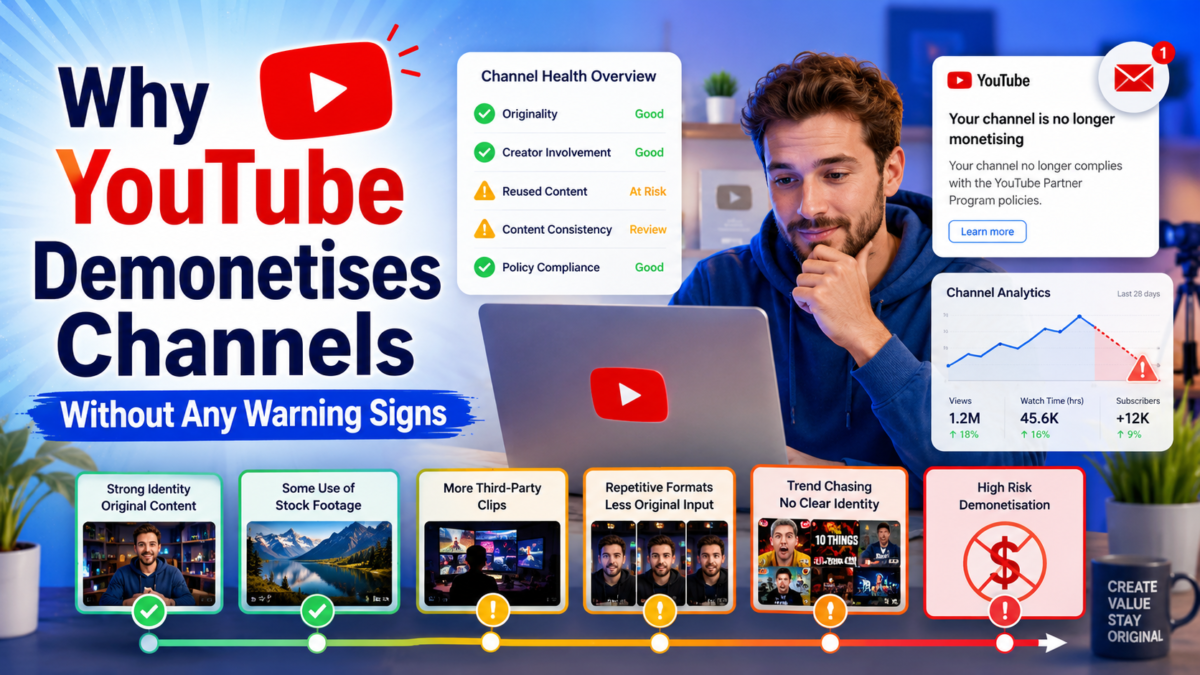
Over the past year, we’ve started noticing a clear shift in how monetisation reviews and policy enforcement play out on YouTube. Content that previously met technical eligibility requirements is now being evaluated more closely for how original or transformative it actually is. In practice, this means publishing patterns, creative ownership, and overall presentation are beginning to matter as much as traditional thresholds. The policy updates through 2025, along with early signals emerging for 2026, point toward a broader change in how content is assessed, moderated, and ultimately monetised.

Monetization & The Authenticity Mandate (YPP 2025)

The central theme of the 2025 policy update is the distinction between original and “inauthentic content”.

Policy Area Key Change / Rule Impact on Creators
Authenticity Focus YouTube clarified rules against “inauthentic” (formerly “repetitious”) content. Channels risk losing monetization if content is mass-produced, repetitive, or lacks clear value-add.
AI Content AI is permitted as a tool, but content generated purely by AI without human transformation is at risk. Must add personal commentary, voiceovers, or creative input to AI-assisted videos.
Originality More emphasis on original content, storytelling, and unique perspectives. Focus shifted from volume to quality and creative input. Basic YPP thresholds remain unchanged.

What We’re Seeing in Practice

In several recent monetisation reviews, the issue hasn’t been one clear violation. More often, it’s a pattern that builds over time. Channels following very similar formats, uploading at scale, or making only small variations between videos tend to face closer scrutiny, even when individual uploads look compliant on their own. In practical terms, this means decisions are increasingly influenced by overall publishing behaviour rather than a simple checklist, making consistent creative differentiation more important than volume alone.

Creator Action Plan:

  • Transform Content: Every video, especially if using reused or AI-assisted material, must feature personal voiceovers, commentary, or significant creative edits.
  • Avoid Bulk Uploads: Resist uploading near-identical content simply to fill a quota.

Platform Safety and Community Guidelines

YouTube continues to strengthen safeguards, particularly for younger audiences, while providing clearer moderation standards.

Safety and Restriction Updates

  • Age-Sensitive Content: Stricter age restrictions now apply to graphic violence (e.g., in gaming) and online gambling/social casino content (often requiring 18+ limits).
  • Moderation Nuance: Updates to “public interest” exceptions allow nuanced debates to remain online, focusing enforcement efforts on content that violates policy regardless of context.

2026 Forward: AI Integration and Platform Evolution

The strategic direction for 2026 revolves around integrating AI into creator workflows and diversifying revenue streams.

Key Developments Expected in 2026

Advanced AI and Creative Tools

Feature Description Goal
AI Shorts Generation Tools to create Shorts, potentially using creators' own AI likenesses. Enhance short-form content production efficiency.
Creator AI Assistance AI for analytics interpretation, content ideation, and editing support. Support creators, not replace them.
Enhanced Formats Integration of still photos directly into the Shorts feed. Broaden creative options for short-form video.

Monetization Diversification

  • YouTube is actively exploring deeper brand integration and in-app shopping features, expanding earning potential beyond traditional ad revenue.

Enhanced Safety

  • The platform is developing improved parental controls and sophisticated content moderation systems to ensure a safer environment for young users.

How PING MCN Supports This Shift

As platform evaluation continues to evolve, many creators and production teams are finding that compliance is no longer limited to individual videos but extends to overall publishing behaviour and content strategy.

PING MCN works with channel owners and studios to interpret these platform signals, review publishing patterns, and help align content operations with evolving monetisation and authenticity expectations. The focus is not only on resolving immediate risks but on building sustainable, policy-aligned growth over the long term.

PING NETWORK WHITE

Drop Your Email & Stay in the Loop