Is the Sale of a YouTube CMS Account Legal? Here Is What YouTube’s Own Policy Says

The Short Answer Is No. But the Long Answer Matters More.

Across social media platforms and creator communities, a specific kind of offer has been circulating with increasing frequency. Someone claims to be selling a YouTube CMS account — complete with Content ID access, original login credentials, linked AdSense, and sometimes even a history of verified revenue. The listing sounds legitimate. The seller presents it as a business transaction. And the buyer, often a creator or small label trying to grow, believes they are getting a shortcut to a powerful tool.

But this is not a shortcut. It is a direct violation of YouTube’s own policies and the consequences fall entirely on the buyer.

What Is a YouTube CMS and Why Does It Matter

YouTube’s Content Management System, commonly referred to as CMS, is not a product you can purchase or subscribe to. It is an enterprise-level platform that YouTube grants, by invitation only, to qualified partners. These include Multi-Channel Networks (MCNs), major music distributors, record labels, and large content rights holders with demonstrated need for rights management at scale.


Through the CMS, approved partners can register music and video assets, use Content ID to claim or monetize user-generated content that includes their work, manage multiple channels from a single dashboard, and control geographic distribution rights. It is a significant operational tool, and YouTube is deliberate about who receives access to it.


The application and approval process exists for a reason. YouTube needs to trust that whoever holds CMS access is operating responsibly, accurately, and in compliance with the platform’s policies at all times.

What YouTube's Policy Actually States
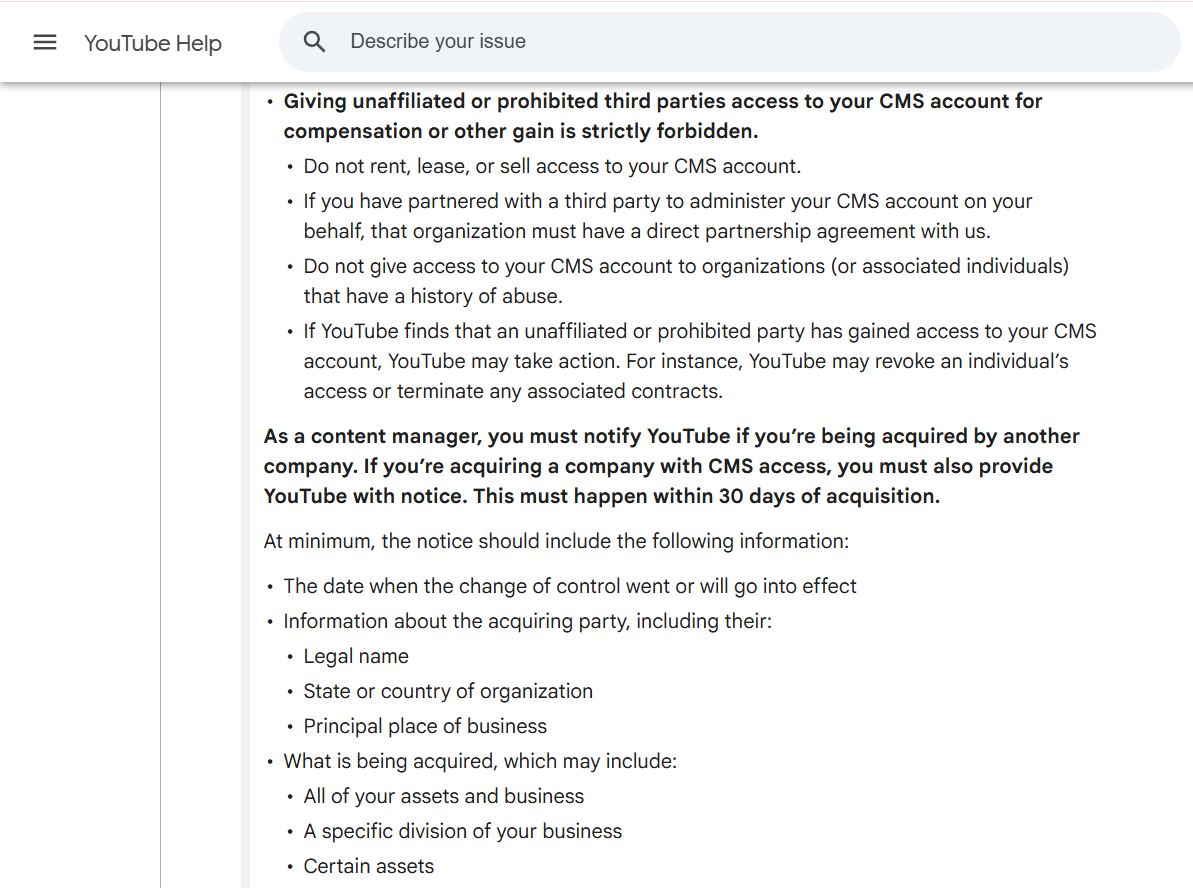
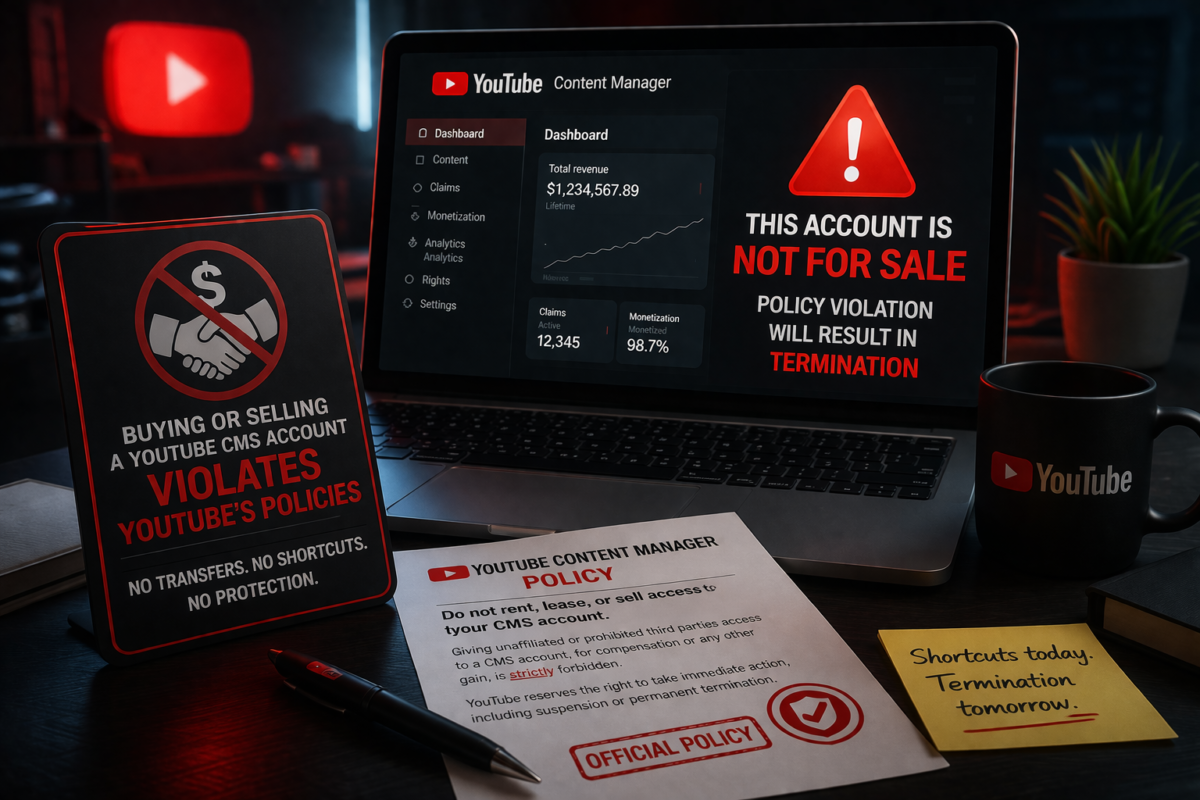
YouTube’s official Content Manager Policies leave no room for ambiguity on this point. The policy explicitly states: do not rent, lease, or sell access to your CMS account. It further specifies that giving unaffiliated or prohibited third parties access to a CMS account, for compensation or any other gain, is strictly forbidden. If YouTube identifies that an unaffiliated party has gained access to a CMS account, the platform reserves the right to take immediate action which includes suspension or permanent termination.

This is not a grey area. It is a named, documented prohibition.

The CMS is granted to a specific legal entity that has entered into a direct agreement with YouTube. That agreement is not transferable. When someone sells a CMS account, they are not selling a product. They are transferring access to a platform relationship that legally belongs to them — and that transfer is not permitted under any circumstances.

Why the Buyer Carries All the Risk

The seller in these transactions typically frames the deal as safe and permanent. They may claim the account is clean, that it has no violations, that the revenue history proves its legitimacy, or that YouTube’s rules somehow permit this kind of sale. None of these claims are accurate.


Once the account changes hands, the original agreement between YouTube and the registered content owner is effectively broken. The buyer is now operating an account that does not belong to them, under credentials that were issued to someone else, and within a legal framework they have no standing in.


If YouTube detects the transfer and it regularly monitors for account behaviour inconsistencies the CMS access will be revoked. Any revenue held in AdSense may be frozen. The channels linked to that account can face penalties. And because the buyer has no legitimate agreement with YouTube, they have no recourse. There is no dispute process. There is no appeal based on having purchased the account. The transaction itself is the violation.

The Pattern in These Listings

A typical CMS account sale listing includes several specific details designed to create the appearance of legitimacy: the year the CMS was applied for and approved, the country of registration, a lifetime revenue figure, and claims that all features are fully operational. The seller may also offer to add the buyer’s bank account to AdSense or assist in transferring the original email credentials.


Each of these elements is a red flag, not a reassurance. Adding a new bank account to an existing AdSense account without YouTube’s knowledge constitutes a form of account manipulation. Transferring original login credentials is explicitly against both YouTube’s and Google’s terms of service. The revenue history belongs to the previous account holder and means nothing once the ownership chain is broken. The seller is not offering a legitimate asset. They are offloading an account with a ticking clock on it.

What Legitimate CMS Access Actually Looks Like

If you are a creator, label, or content rights holder who needs the kind of tools a CMS provides, there is only one compliant path: working with a YouTube-certified MCN or rights management partner that already holds CMS access and has a direct partnership agreement with YouTube.


An MCN like Ping Network operates under a formal agreement with YouTube. When a creator or label partners with us, their content is managed within a compliant, verified framework. There are no credential transfers. No account manipulation. No risk of sudden termination. The rights remain with the actual owner. The tools function as YouTube intends them to. This is not just the safer option. It is the only option that is actually legal.

A Final Word for Anyone Who Has Seen These Listings

If you have come across an offer to buy a YouTube CMS account, the safest action is to not engage. The price may seem reasonable. The revenue history may seem impressive. The seller may seem confident. But the moment you take ownership of that account, you are operating in violation of YouTube’s policies, with no legal protection and no recourse if the access is revoked. The right question is not whether the account looks legitimate. The right question is whether your relationship with YouTube is legitimate. One can only be built properly, through the right channels.

At Ping Network, we work with creators and rights holders who want to grow on YouTube the right way — with full compliance, transparent agreements, and tools that actually belong to them.
All About Public Domain, Fair Use & Copyright

One of the biggest misconceptions in the creator ecosystem is this:
“If it’s available online, I can use it.”
This assumption is the root cause of most copyright claims, demonetisation issues, and even channel strikes. The reality is more structured. Every piece of content, music, video clips, images, and film footage exists under a specific legal status. And unless you understand that status clearly, you’re always at risk of using something you don’t actually have the right to use. Three terms come up repeatedly in this context: copyright, public domain, and fair use. They are often used interchangeably, but they mean very different things and confusing them can cost you your monetisation.

Copyright: The Default Rule

By default, almost everything you see online is protected by copyright. The moment a piece of content is created, whether it’s a song, a film clip, a podcast, or even a short video, it automatically belongs to its creator or rights holder. This means no one else can reuse, upload, or monetise it without permission. On YouTube, this system is enforced through Content ID and manual claims. If you upload copyrighted material without the rights, the platform can:

  • Claim your video and redirect revenue
  • Restrict visibility or block it in certain countries
  • Issue a strike in more serious cases

What’s important to understand is that crediting the original creator does not give you permission. Neither does adding a disclaimer. Copyright is not about intent; it’s about ownership.

Public Domain: What You Can Freely Use

Public domain content is the safest category for creators.
When a work enters the public domain, it means it is no longer protected by copyright. This usually happens after a certain number of years (depending on the country) or when the creator explicitly releases it for public use. This allows you to:

  • Use the content freely
  • Modify or edit it
  • Monetise it without permission

However, the challenge is not access it’s accuracy. Just because something looks old or widely available does not mean it is in the public domain. Many creators assume that vintage clips, old songs, or historical footage are free to use, but that is not always true. Different countries have different copyright durations, and some works remain protected much longer than expected. Another common mistake is confusing “royalty-free” with public domain. Royalty-free content still comes with a license you are allowed to use it under certain conditions, but you don’t own it. Public domain, on the other hand, has no such restrictions.

Fair Use: The Most Misunderstood Concept

Fair use is where most creators get into trouble. It is often treated as a loophole, something that allows you to use copyrighted material as long as you add commentary or make slight changes. But fair use is not a rule you can claim. It is a legal defence that is evaluated case by case. On YouTube, fair use generally applies when the content is transformative—meaning you are adding significant value, not just reusing the original. Examples where fair use may apply:

  • Commentary or criticism
  • Educational breakdowns
  • Reviews or analysis
  • Parody

But even in these cases, there is no guarantee. Using a full movie scene with minimal commentary, or repurposing someone else’s content with light edits, is unlikely to qualify. The more your content depends on the original material, the weaker your fair use position becomes. Another key point: YouTube’s systems do not “approve” fair use automatically. Content ID can still claim your video. At that stage, you can dispute the claim but the final decision may involve the rights holder, and in some cases, legal escalation. So while fair use exists, it is not a safe strategy for consistent monetisation.

Where Creators Go Wrong

Most copyright issues don’t come from intentional misuse; they come from misunderstanding. Creators assume that adding voiceover, trimming clips, or changing background music is enough to make content original. Others believe that if a video is already available on YouTube, it must be reusable. Some rely heavily on fair use without fully understanding how subjective it is. Others use “free” content from the internet without verifying whether it is truly in the public domain or simply licensed under specific terms. The problem is not creativity, it is clarity. And on a platform like YouTube, where monetisation depends on compliance, this lack of clarity directly affects revenue.

Best Long-Term Monetisation Strategy

If your goal is to build a stable, monetised channel, the safest approach is simple: own or properly license what you use.
This could mean:

  • Creating original content
  • Using assets with clear commercial licenses
  • Working with partners who manage rights and permissions

Public domain content can be a strong resource if verified correctly. Fair use can work in specific formats like commentary or education, but it should not be treated as a default strategy. Because at scale, unpredictability becomes risk.

Conclusion

Copyright is not just a legal framework; it is the foundation of how YouTube’s ecosystem functions. Every view, every ad, and every payout is tied to ownership. Creators who understand this build channels that are not only creative but also secure and monetisable. Those who don’t often find themselves dealing with claims, blocked videos, or lost revenue sometimes after investing significant time and effort. The difference is not talent. It is understanding what you truly have the right to use.

Want Experts To Manage Your Content Safety?

Copyright issues don’t just affect your videos; they affect your revenue, your reach, and your long-term channel stability. At Ping, we help creators navigate content rights, resolve claims, and set up systems that protect both their content and their earnings. If you’re using third-party content or planning to scale your channel, getting this right early makes all the difference. Explore Ping Network to build a copyright-safe and monetisation-ready YouTube strategy.

Everything Creators Need to Know About YouTube Policy Update

Over the past year, we’ve started noticing a clear shift in how monetisation reviews and policy enforcement play out on YouTube. Content that previously met technical eligibility requirements is now being evaluated more closely for how original or transformative it actually is. In practice, this means publishing patterns, creative ownership, and overall presentation are beginning to matter as much as traditional thresholds. The policy updates through 2025, along with early signals emerging for 2026, point toward a broader change in how content is assessed, moderated, and ultimately monetised.

Monetization & The Authenticity Mandate (YPP 2025)

The central theme of the 2025 policy update is the distinction between original and “inauthentic content”.

Policy Area Key Change / Rule Impact on Creators
Authenticity Focus YouTube clarified rules against “inauthentic” (formerly “repetitious”) content. Channels risk losing monetization if content is mass-produced, repetitive, or lacks clear value-add.
AI Content AI is permitted as a tool, but content generated purely by AI without human transformation is at risk. Must add personal commentary, voiceovers, or creative input to AI-assisted videos.
Originality More emphasis on original content, storytelling, and unique perspectives. Focus shifted from volume to quality and creative input. Basic YPP thresholds remain unchanged.

What We’re Seeing in Practice

In several recent monetisation reviews, the issue hasn’t been one clear violation. More often, it’s a pattern that builds over time. Channels following very similar formats, uploading at scale, or making only small variations between videos tend to face closer scrutiny, even when individual uploads look compliant on their own. In practical terms, this means decisions are increasingly influenced by overall publishing behaviour rather than a simple checklist, making consistent creative differentiation more important than volume alone.

Creator Action Plan:

  • Transform Content: Every video, especially if using reused or AI-assisted material, must feature personal voiceovers, commentary, or significant creative edits.
  • Avoid Bulk Uploads: Resist uploading near-identical content simply to fill a quota.

Platform Safety and Community Guidelines

YouTube continues to strengthen safeguards, particularly for younger audiences, while providing clearer moderation standards.

Safety and Restriction Updates

  • Age-Sensitive Content: Stricter age restrictions now apply to graphic violence (e.g., in gaming) and online gambling/social casino content (often requiring 18+ limits).
  • Moderation Nuance: Updates to “public interest” exceptions allow nuanced debates to remain online, focusing enforcement efforts on content that violates policy regardless of context.

2026 Forward: AI Integration and Platform Evolution

The strategic direction for 2026 revolves around integrating AI into creator workflows and diversifying revenue streams.

Key Developments Expected in 2026

Advanced AI and Creative Tools

Feature Description Goal
AI Shorts Generation Tools to create Shorts, potentially using creators' own AI likenesses. Enhance short-form content production efficiency.
Creator AI Assistance AI for analytics interpretation, content ideation, and editing support. Support creators, not replace them.
Enhanced Formats Integration of still photos directly into the Shorts feed. Broaden creative options for short-form video.

Monetization Diversification

  • YouTube is actively exploring deeper brand integration and in-app shopping features, expanding earning potential beyond traditional ad revenue.

Enhanced Safety

  • The platform is developing improved parental controls and sophisticated content moderation systems to ensure a safer environment for young users.

How PING MCN Supports This Shift

As platform evaluation continues to evolve, many creators and production teams are finding that compliance is no longer limited to individual videos but extends to overall publishing behaviour and content strategy.

PING MCN works with channel owners and studios to interpret these platform signals, review publishing patterns, and help align content operations with evolving monetisation and authenticity expectations. The focus is not only on resolving immediate risks but on building sustainable, policy-aligned growth over the long term.

Introducing Video-wise Content ID Protection

In today’s creator economy, protecting your original content is just as important as creating it. Every video you upload represents your creativity, effort, and potential revenue, yet without the right protection, it can easily be reused or monetised by someone else.

That’s where YouTube’s Content ID system comes in as a powerful tool that detects and manages unauthorised re-uploads of your videos across the platform.

Why Content ID Matters

For most independent creators, access to YouTube’s Content ID is limited. Only networks, rights holders, or large production companies typically get direct access to the system. This means that individual creators, even those producing high-quality original content, often have no way to protect their videos beyond manual copyright claims, which are slow and inconsistent.

With Content ID, creators can:
1. Automatically detect copies of their videos across YouTube.

2. Choose what happens next — monetise, track, or block those copies.

3. Earn additional revenue when others reuse their work legitimately.

4. It’s the ultimate protection-plus-monetisation tool for serious creators.

Ping Network’s New Offering: Content ID Without Channel Linking

At Ping Network, we’re making this powerful technology accessible to more creators, but with a difference. Traditionally, to get Content ID protection through an MCN (Multi-Channel Network), creators had to link their entire channel to the MCN’s YouTube CMS. That can feel restrictive, especially for creators who want to retain full independence and control over their channels.

With our new Video-wise Content ID service, that’s no longer necessary.
You can now protect specific videos without linking your entire channel to our CMS.

That means:
✅ You keep complete control of your channel.
✅ Only the selected videos are added under Content ID protection.
✅ We handle the claim management, reporting, and monetisation transparently.

It’s flexible, simple, and designed for creators who value both freedom and security.

A Win-Win-Win Partnership

Our goal is to make Content ID accessible, affordable, and beneficial for everyone involved: the creator, the rights holder, and Ping Network.

Win for Creators: Your original work stays protected, and you earn from any reuse.

Win for the Platform: Cleaner rights management means a healthier ecosystem.

Win for Ping: We grow alongside creators who trust us to manage their content responsibly.

We offer minimal monthly charges, depending on the number of videos you choose to protect. No hidden fees, no long-term lock-ins, just transparent support.

Protect. Monetize. Grow.

If you’re a creator who regularly invests in high-quality videos from music and short films to educational and entertainment content, this is your chance to take control of your rights and earnings.

👉 Get your videos protected with Ping’s Video-wise Content ID Service.
Reach out to us, visit www.pingnetwork.in to get started.

🚨 YouTube’s New AI Content Policy: What It Means for Creators (And How to Stay Safe)

In July 2025, YouTube made a major announcement that has left many YouTube creators confused, worried, and curious.

“Is YouTube banning AI-generated content?”
“Will my monetization be removed?”
“Can I still use tools like ChatGPT or text-to-voice AI?”

As the best YouTube CMS providers, we at Ping Network work with creators every day. So we’ve broken it all down for you: what this new update says, how it affects you, what you should and shouldn’t do, and how you can still use AI—legally and ethically to boost your creativity without putting your channel at risk.

What Exactly Is the New YouTube Update?

On July 15, 2025, YouTube updated its monetization policies to crack down on what it calls “reused, low-quality, and mass-produced content.” This mostly targets AI-generated videos that are published in bulk without much human involvement.

This doesn’t mean you can’t use AI at all.

But it does mean you can’t rely only on AI to create videos that:

  • Look the same every time
  • Have no real personal or creative touch
  • They are made just to “game” the algorithm

Is YouTube Banning AI Content?

No, YouTube is not banning AI-generated content.
But it is demonetizing (removing ads and earnings) from content that:

  • Is auto-generated with very little editing or value
  • Is overly repetitive or looks like it’s been mass-produced
  • Uses synthetic voiceovers without personality or context
  • Is copied from other sources without significant transformation

In short: If your video looks like it was made in 5 minutes with zero thought, you’re at risk.

Examples of Content That Might Get Demonitized

  • A video with just a robot voice reading a Wikipedia article
  • A slideshow of stock photos with AI narration and no editing
  • Re-uploading someone else’s content with minor changes
  • Publishing 10 similar videos daily with no unique angle

Even if AI made it easier for you, YouTube is asking: “Did YOU bring anything original to this?”

What Kind of AI Use is Still Safe?

Here’s the good news: You can still use AI as a tool.
You just need to use it responsibly and creatively.

  • Using AI to brainstorm video ideas.
  • Creating rough drafts or outlines for your script.
  • Voiceovers with real emotion and editing.
  • Editing help like captions, cut suggestions, or B-roll search.
  • AI visuals that are combined with your original commentary or story
    🔑 Key Rule: AI should assist your creativity—not replace it.

Do’s and Don’ts: Staying Safe Under the New Policy

How Creators Can Still Use AI Without Breaking the Rules

DO

  • Add your personal voice, insights, or emotions
  • Show your face, speak on camera, or narrate in your own voice
  • Edit AI content meaningfully—cut, comment, explain, remix
  • Use AI for support, not full automation
  • Be transparent if you’re using AI for storytelling or visuals

DON’T

  • Rely entirely on text-to-video AI tools for your uploads
  • Publish content that feels soulless or robotic
  • Upload repetitive formats (same template, different topic)
  • Use AI to copy or summarize articles and pass it off as your own
  • Expect quantity over quality to succeed anymore
AI is like a camera, an editing app, or a scriptwriting tool—it’s powerful if used right. Here’s how you can use it smartly:

Why Is YouTube Doing This?

Because the platform is getting flooded with AI spam.
Thousands of faceless channels are uploading junk content created with a few prompts and monetizing it without adding any value to viewers.
YouTube wants to:

  • Encourage original storytelling
  • Maintain quality content for users
  • Reward human creativity, not robotic repetition

This is not a punishment, it’s a course correction.

Ping Network’s Advice to Creators
Here’s what we at Ping recommend to stay compliant and still grow your channel using AI:

Audit your recent videos

Are they repetitive? Lacking personality?

Mix in human presence

Use your voice, face, opinion, or humor

Use AI for support, not shortcuts
Update your "About" section

to show transparency in your process

Final Thoughts

YouTube isn’t against AI.
It’s against lazy, soulless, low-effort content. Whether it’s made by a human or a machine.

If you’re a thoughtful creator who uses AI as a tool, not a crutch—you’re safe.
You’re ahead of the game.

Have Questions?

Do you make such authentic and appealing content? Want us to partner with you to enhance your content even more? 📩 Reach out to us at Contact. We’ll help you grow safely and smartly.

❓ Frequently Asked Questions (FAQ)

Is YouTube banning all AI-generated content?
No, YouTube is not banning AI-generated content. It is targeting low-effort, repetitive, or inauthentic content that appears mass-produced—often made entirely by AI with little or no human input. If you’re using AI responsibly and creatively, you’re still in the clear.
Yes, you can. But don’t rely on them alone. Use ChatGPT for ideas or rough scripts, then rewrite them in your tone. If using AI voiceovers, make sure they are expressive, edited well, and part of a video that offers value beyond just AI narration.

Not automatically. YouTube’s focus is on current and future uploads. However, if your older videos are flagged as repetitive or inauthentic, they might be reviewed or demonetized. We recommend reviewing past uploads and unlisting or improving any that may appear low-effort or auto-generated.

How To Turn Your Content Into Revenue: PING MCN Makes AVOD Work for You

In a world where subscriptions are maxed out and audiences crave free content, AVOD (Ad-Supported Video on Demand) has emerged as the most underutilized goldmine for content owners.
Being the best MCN in India, at PING MCN, we help film studios, sports leagues, TV producers, and global aggregators unlock new revenue from their content libraries, without giving up rights or control. Whether you’ve got legacy films, unreleased TV content, or sports archives gathering dust, AVOD—especially on YouTube, offers a powerful opportunity.
Let’s walk you through how it works and how we help.

First Things First: What Exactly Is AVOD?

AVOD stands for Ad-Supported Video on Demand. Simply put, instead of asking audiences to pay to watch your content (like Netflix or Disney+), AVOD platforms such as YouTube offer it for free and generate revenue through advertising.
For creators and rights owners, it’s a win-win:

  • Your content becomes instantly accessible to millions globally
  • You earn revenue every time someone watches without building your platform
  • Even older or under-promoted content can find new life (and earnings)

Why AVOD Is Taking Over And Why You Should Consider This Now

Audiences are overwhelmed with subscriptions. With multiple paid streaming apps on the market, users are cutting back. AVOD offers a “free to watch” experience that’s gaining massive traction. especially in emerging markets.

YouTube is leading this shift. With over 2 billion monthly logged-in users and an advanced ad platform, YouTube is now the world’s largest AVOD platform. It’s where global audiences discover new films, follow athletes, and binge content across languages and cultures.

Emerging markets are watching, but hard to monetize. Countries like Egypt, Vietnam, and parts of MENA and South Asia are consuming more content than ever, but USD payouts, tax issues, and policy barriers make it hard to monetize directly. That’s where we come in.

Here’s How Ping MCN Helps You Make the Most of YouTube

Our AVOD stack is designed for content owners who want to scale safely, compliantly, and profitably. without building a team from scratch. And to do so, here’s what we offer

SEO (search engine optimization)

We optimize your videos with SEO-friendly titles, descriptions, and tags to boost discoverability, rank higher in search results, and attract the right audience.

CMS Access & Onboarding

We onboard your films, shows, or sports footage into our YouTube-affiliated CMS, so you don’t need to worry about backend setups or AdSense headaches. You keep creative and rights control. We just handle the infrastructure.

Content ID Setup & Optimization

Using YouTube Content ID, we track and claim any UGC (user-generated content) that uses your footage. From trailers to clips to fan edits, we ensure you earn from every use, not just your uploads.

Territorial Rights Management & Geo-Blocking

Have your film licensed in one country but not another? We enforce geo-blocking to protect your contracts while enabling monetization in available territories. This keeps your legal teams happy and your earnings active.

Ad Monetization Optimization

We optimize where and how ads appear on your content using smart pre-roll/mid-roll strategies, improving RPM (revenue per thousand views), and adjusting for regional audience behavior. Small tweaks, big returns.

We Keep the Numbers Crystal Clear

Our reporting dashboard gives you full visibility:

  • Title-level and country-level earnings
  • Forecasts and trends
  • Monthly USD-based payouts via PayPal or Payoneer No spreadsheets. No chasing data. Just clarity.

Policy & Compliance Support

YouTube changes its rules often. We guide you through:

  • Copyright and policy standards
  • Metadata best practices
  • Ad Policy and monetization eligibility
So your content reaches the right audience and stays visible, monetized, and protected.

Who We Work With

We work best with creators who own high-potential content but need help unlocking its revenue on YouTube. Here are just a few examples:

Aggregators in Egypt, Vietnam, and Turkey

We help regional rights holders navigate payout restrictions, geo-monetization, and cross-border compliance. Our team bridges the gap between global platforms and local complexity.

🚀 Don’t Let Your Content Sit Idle. It Can Be Earning Today.

If you’re sitting on a content catalog that’s under-monetized or worse, untouched, now is the time. You don’t need to build an app, hire an in-house tech team, or chase new distributors. You just need the right partner who understands the platform, knows the policies, and identifies the possibilities.

Curious to See What’s Possible with your content?

Let’s talk about how your content can start earning globally, compliantly, and efficiently.
Whether you’re :

  • 🎬 Film studio with digital rights
  • 📺 TV producer testing YouTube-first distribution
  • ⚽ Sports federation with legacy footage
  • 🌍 Aggregators from Egypt, Turkey, Vietnam, or beyond

We’re here to help you scale.

👉 Email us: partner.support@pingnetwork.in
👉 Or book a quick discovery call: https://www.pingnetwork.in

MCN vs. Going Solo: Why Smart Creators Choose Media Support

Why Every Creator Needs a Media Partner to Truly Grow

The internet has made it possible for anyone with a camera and a story to become a creator. But as the creator economy grows, so does the pressure to be everywhere, do everything, and somehow still stay creative. If you’re a creator, you’ve probably felt it: the constant balancing act between making great content and managing everything else—production, optimization, publishing, monetization, community building, and brand outreach. It’s more than a full-time job.

And that’s the real reason why more creators today are choosing to work with media partners or MCNs (Multi-Channel Networks). Not just to “get more views,” but to build something sustainable, strategic, and scalable.

Creating is Just One Part of the Journey

Let’s face it: great content doesn’t always equal great results. You might have a powerful voice, an inspiring story, or a loyal community—but if your content isn’t reaching the right audience, getting discovered, or being monetized effectively, you’re leaving potential on the table. A media partner brings structure to the chaos. They step in where creators often burn out—handling the behind-the-scenes work so creators can focus on their craft.

What a Good Media Partner Really Does

🛠 Handles the Tools, So You Can Focus on the Talent

From SEO to scheduling, policy issues to thumbnails—media partners understand platforms like YouTube inside out. They take care of the details that affect performance but often get overlooked.

🎬 Adds Professionalism to the Process

You don’t need to do it all alone. With access to production support, editors, and strategists, your content not only gets created—it gets elevated.

📈 Helps You Grow with Purpose

It’s not just about going viral. It’s about building a sustainable audience, analyzing what works, and improving over time. Media partners bring data, experience, and insight into your creative process.

🔐 Protects Your Content and Monetization Rights

A creator’s work is their IP. Having a CMS-enabled partner means better asset protection, policy control, and revenue tracking across platforms.

🤝 Opens Doors to Brands and Collaborations

As a solo creator, it’s tough to break into brand networks or organize collaborations. A media partner connects you with like-minded creators and helps you land meaningful partnerships, not just one-off deals.

It’s Not About Giving Up Control—It’s About Getting the Right Support

The conversation around MCNs has always been framed incorrectly. Most creators assume that joining a network means handing over control, when in reality, the bigger problem today isn’t control; it’s clarity.

In 2026, creators are not struggling to upload content. They are struggling to understand why some content works and some doesn’t. A video gets impressions but no clicks. Another gets clicks but drops in retention. A third performs well but doesn’t scale. These are not effort problems; they are interpretation problems. This is where the idea of support becomes relevant. Not in the form of someone managing your channel, but in the form of someone helping you read what’s actually happening. Because when you are too close to your own content, it becomes difficult to objectively assess it. The right media partner doesn’t limit your creative control. It removes the friction between effort and outcome. It helps you see patterns, make better decisions, and build direction into your content instead of relying on trial and error.

So, Why Not Just Go Solo?

Going solo works—until it doesn’t. Most creators experience initial growth through experimentation. They try different formats, follow trends, and eventually something clicks. But over time, that growth starts becoming inconsistent. Videos stop compounding. What worked earlier stops working the same way. This is where the limitation of going solo becomes visible. When you are working alone, every decision comes from your own perspective. You are analyzing your own data, validating your own ideas, and correcting your own mistakes. That loop can only take you so far because it lacks external reference.
The issue is not capability. It’s visibility. You don’t always know whether a problem lies in your content, your packaging, or your audience targeting. And without that clarity, most creators either overcorrect or stay stuck repeating the same patterns. A structured support system changes that. It brings in context from outside your channel—patterns observed across different creators, different niches, and different audience behaviors. That broader view helps you make more informed decisions, faster. The difference is not in effort. It’s in direction.

The creator economy is growing—but so is the competition. The smartest creators aren’t doing more. They’re doing what they do best—and letting the right partners do the rest.

Let Ping Be That Partner

At Ping Network, the approach is built around one simple idea—creators don’t need control taken away, they need clarity added. Instead of forcing creators into rigid systems, the focus is on understanding what is already happening on their channel and improving it. Why is a video being pushed but not converting? Why does certain content attract new viewers but fail to bring them back? Why monetisation feels limited despite consistent uploads. From there, the goal is to build structure. Not just in content, but in how the channel grows, how revenue is generated, and how decisions are made.

At the same time, flexibility remains important. Not every creator wants full channel-level involvement. That’s why solutions like video-wise Content ID protection exist—allowing creators to protect and monetise their content without handing over their entire channel. Because ultimately, growth today is not about doing more. It’s about doing the right things consistently. If you’re at a stage where effort is not translating into results, the problem is rarely your content alone. It’s the lack of a system around it. And that’s exactly where the right partner makes the difference.

YouTube’s Content ID: The Key to Protecting and Monetizing Your Creative Content

How to Protect and Monetize Your Creative Content with YouTube’s Content ID

In the digital age, protecting your creative content is essential. Whether you’re a musician, filmmaker, or content creator, ensuring your work isn’t used without permission is critical. One of the most effective ways to do this on YouTube is through YouTube’s Content ID system. This powerful tool helps creators protect, manage, and monetize their content on the platform.

What is YouTube Content ID?

YouTube’s Content ID is an automated system designed to detect and protect copyrighted content. It works by scanning every video uploaded to YouTube against a massive database of registered copyrighted materials. If the system finds a match, the copyright owner can decide whether to monetize, block, or track the video.

Why Content ID is Crucial for Protecting Your Work

If you’re searching for ways to protect your content online, here’s why YouTube’s Content ID is a must-have:

1. Automated Copyright Protection

Content ID automatically identifies when your copyrighted material (such as music, video clips, or other media) is used in other uploads. This saves creators the hassle of manual searches and takedown requests.

2. Monetize Unauthorized Use of Your Content

Instead of removing videos that use your content without permission, Content ID allows you to monetize these instances by displaying ads. This way, creators can generate passive income every time their work is used by others on YouTube.

3. Control Where and How Your Content is Distributed

You can decide where your content can be viewed, choosing to restrict it in certain regions or even block it altogether. This ensures you’re in control of your intellectual property’s global distribution.

4. Prevent Time-Consuming Manual Takedowns

Without Content ID, creators would have to manually monitor and submit copyright infringement claims. YouTube’s Content ID simplifies this process by automating copyright enforcement, giving creators more time to focus on producing content.

5. Maintain Brand Integrity

Content ID ensures that your content is only used in ways that align with your brand. By controlling how and where your work is used, you reduce the risk of your content being misrepresented or associated with inappropriate materials.

6. Gain Insight into How Your Content is Used

With detailed analytics, Content ID helps you track where and how your content is being used across YouTube. This allows you to understand the reach and performance of your intellectual property on the platform.

How Content ID Helps Monetize Your Creative Content

Many creators search for ways to monetize their content, and YouTube’s Content ID offers a unique opportunity to do just that:

- Monetize User-Generated Content:

Content ID provides data on where and how your content is being reused, so you can make informed decisions about future monetization strategies.

- Track Usage Across Multiple Channels:

If a fan or another creator uses your music, clips, or other media in their videos, Content ID can automatically place ads on these videos, allowing you to earn revenue.

New AI Detection Tools to Protect Your Content

As AI-generated content grows in popularity, YouTube is rolling out new tools to help protect creators from unauthorized AI-generated media. These tools will be part of Content ID and are designed to identify AI-generated vocals and likenesses.

1. AI-Generated Vocal Detection

YouTube is introducing a tool that detects AI-generated soundalike vocals. This feature will help musicians protect their voices from unauthorized AI-generated songs that mimic their style or tone.

2. AI-Generated Likeness Detection

For actors, musicians, and other public figures, YouTube is developing technology to detect AI-generated deepfakes. This will protect creators from unauthorized use of their likeness in AI-generated videos.

Combating Unauthorised AI Training on YouTube

YouTube is cracking down on scraping its content for AI training without permission. This action is in response to growing concerns about the use of copyrighted material to train AI models without the consent of the content owner. YouTube is committed to giving creators more control over how their work is used in AI-related projects.

Why You Should Use YouTube Content ID to Protect Your Content

If you’re looking for effective ways to protect your creative content and ensure your intellectual property is not misused, YouTube Content ID is the answer. Whether you’re a musician, filmmaker, or YouTuber, Content ID can help you:

  • Automatically protect your work from unauthorized use.
  • Monetize your content even when it’s used by others.
  • Maintain control over where and how your content is viewed

Partner with Ping Network to Access Content ID and Maximize Your Revenue

If you’re ready to take control of your content, Ping Network can help you access YouTube’s Content ID system. We offer tools and services to help creators protect, monetize, and manage their intellectual property effectively. Connect with us today and start maximizing your earnings on YouTube!

Unlocking the Potential of Digital Rights Management

How YouTube’s Content ID System is Revolutionizing the Industry

In the ever-evolving digital landscape, content is king. But protecting this content while ensuring that creators can monetize their work has posed significant challenges. Enter YouTube’s Content ID system, a ground breaking solution that has transformed how digital rights are managed and monetized on one of the world’s largest video platforms.

A Technological Marvel in Rights Management

At the heart of YouTube’s rights management is the Content ID system. This advanced tool uses state-of-the-art technology to scan and match uploaded videos against a vast database of copyrighted content provided by copyright owners. This process not only automates the identification of copyrighted material but also streamlines the management process for rights holders.

Automated Detection and Management

Content ID’s automated detection system offers a seamless way for copyright owners to protect their content at scale. With millions of videos uploaded every day, the manual tracking of copyrighted material is impractical. Content ID automates this process, ensuring that copyrighted content is identified quickly and accurately.

Flexibility for Rights Holders

One of the system’s most significant advantages is the flexibility it offers copyright owners in managing their content. Upon detection of a match, rights holders can choose to block the video, monetize it by running ads, or simply track the video’s viewership statistics. This flexibility allows copyright owners to tailor their strategy to fit their needs, whether they’re focused on protecting their intellectual property, generating revenue, or gaining insights into their content’s reach.

Unlocking Revenue Opportunities

Perhaps the most impactful aspect of Content ID is its ability to unlock new revenue streams for content creators and copyright owners. By monetizing matched content, rights holders can earn revenue from their work even when it is used by others on the platform.

Monetization through Ad Revenue

When a copyright owner opts to monetize matched content, YouTube places ads on the video, with the revenue generated from these ads shared with the copyright owner. This system not only compensates rights holders for the use of their work but also incentivizes the creation of original content.

Expanded Reach and Engagement

Content ID also offers an indirect revenue opportunity through increased reach and engagement. By allowing their content to remain on the platform, copyright owners can benefit from enhanced visibility and audience engagement, which can lead to increased followers and potential revenue streams from other platforms or merchandise sales.

Navigating Challenges with Innovation

YouTube’s Content ID system is not without its challenges, including balancing copyright protection with fair use and managing false positives. However, YouTube continuously innovates and updates its algorithms to address these issues, demonstrating a commitment to fair and effective rights management.

As we look towards the future, the continuous evolution of Content ID and similar technologies will be critical in navigating the complexities of digital copyright laws. These systems not only safeguard the interests of copyright owners but also open the door to innovative content monetization strategies, ensuring that the digital content ecosystem remains vibrant and equitable.

For Original Creators and Artists

If you are an original creator or artist and believe your content is being uploaded to YouTube in an unauthorized manner, it’s crucial to take action to protect your intellectual property. YouTube has established mechanisms to assist copyright owners in managing their content and ensuring they are fairly compensated for its use.

To address unauthorized use of your content, we encourage you to contact us by filling out the form available here. This step is the beginning of the process to assert your rights, allowing YouTube to take appropriate action based on your copyright claims. Protecting your work is paramount, and YouTube’s policies and tools are designed to support creators in safeguarding their intellectual property rights.

Remember, the digital world thrives on creativity and collaboration. By taking the necessary steps to protect your content, you contribute to a healthy, respectful, and legally compliant online community.

How can I monetize my YouTube Channel using MCN?

There are a few ways to monetize your YouTube channel using a Multi-Channel Network (MCN):

1. Advertising Revenue:

 MCNs can provide you with access to exclusive advertising deals and opportunities with brands. You can also use the MCN to get access to ad sales reps for higher CPM rates and revenue. 

2. Sponsorship Deals:

MCNs can help you land sponsorship deals with brands and advertisers. You can also use the MCN’s influencer marketing platform to create sponsored content and generate income.

3. Digital Product Sales:

MCNs can provide you with access to different digital products and services that you can promote and sell on your channel.

4. Affiliate Marketing:

MCNs can provide you with access to different affiliate programs and products that you can promote on your channel.

5. Merchandise Sales:

MCNs can provide you with access to merchandise stores and other services that you can use to create and sell your own merchandise. 

6. Crowdfunding:

MCNs can provide you with access to crowdfunding platforms and services that you can use to raise funds for your channel.

PING NETWORK WHITE

Drop Your Email & Stay in the Loop