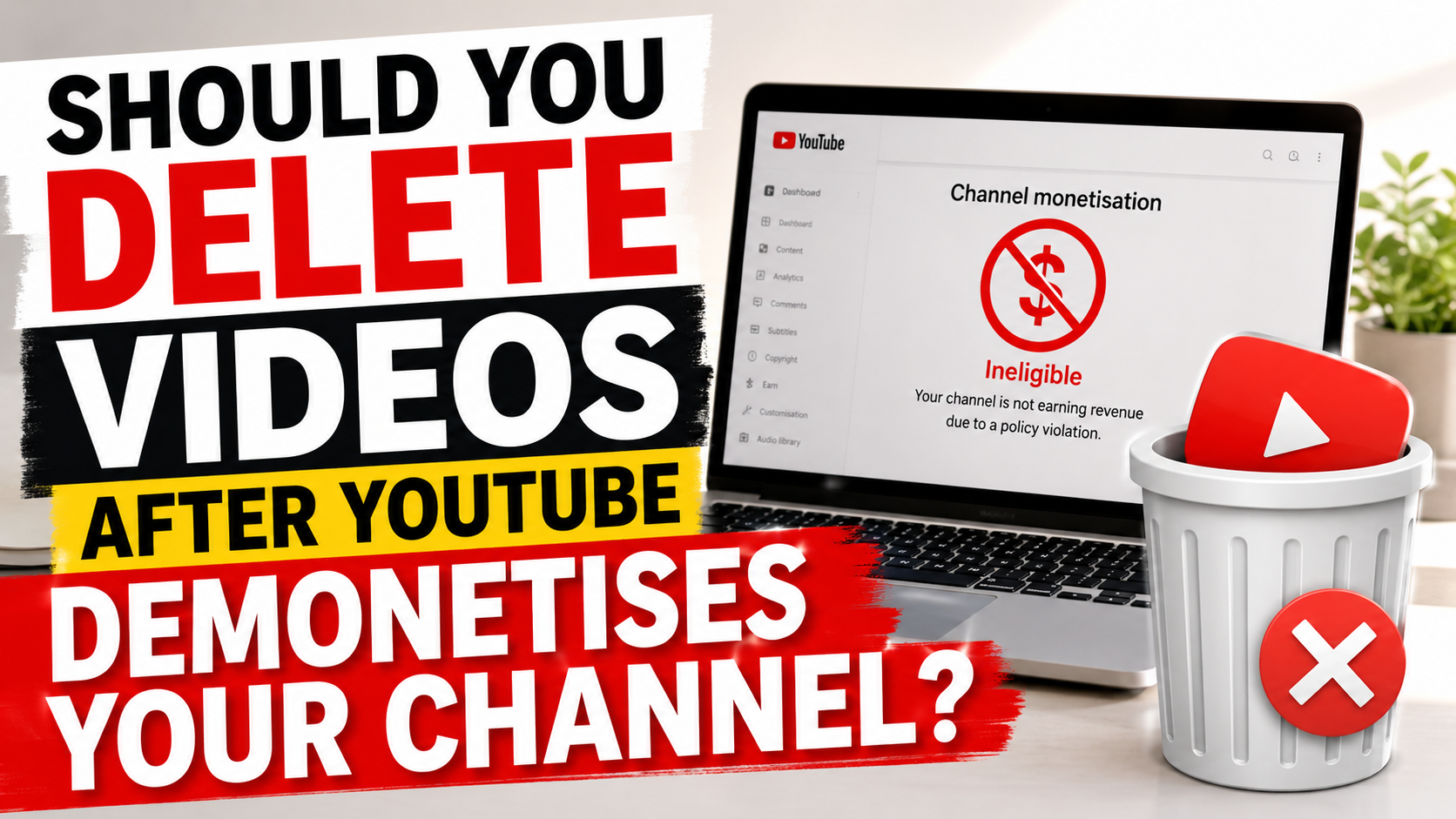
Receiving a YouTube demonetisation email can feel like months or even years of hard work have been undone overnight. For many creators, the first instinct is to fix the problem as quickly as possible. They begin deleting videos, making entire playlists private, changing titles and thumbnails, rewriting descriptions, or even removing hundreds of uploads in a single day. The hope is simple: if the problematic content disappears, monetisation will return. Unfortunately, that is not how the process usually works.
In many cases, these rushed decisions make it more difficult to understand what actually caused the demonetisation in the first place. Worse still, deleting content without a clear strategy can remove valuable evidence that could have helped identify the underlying issue. Before making any major changes to your channel, it is important to understand how YouTube reviews monetisation decisions and why a measured approach is often far more effective than a rapid clean-up.
Why Creators Should Not Rush to Delete Videos
When a channel loses monetisation, there is rarely a detailed explanation identifying every video or every issue that contributed to the decision. The notification usually references YouTube’s monetisation policies or the YouTube Partner Program, but it does not provide a checklist of specific videos to remove. This uncertainty creates panic.
Creators often search online for quick answers and are met with conflicting advice. One person recommends deleting every video with reused footage. Another suggests making the entire channel private. Someone else insists that changing titles and thumbnails is enough to satisfy YouTube’s reviewers. While these suggestions may have worked in isolated situations, applying them blindly to every channel can do more harm than good. The reality is that no two demonetisation cases are exactly alike. A solution that helped one creator recover may be completely irrelevant to another.
Deleting Videos Does Not Automatically Restore Monetisation
One of the biggest misconceptions is that removing content instantly solves the problem.
YouTube does not simply check whether a particular video still exists. During a monetisation review, reviewers assess whether the channel as a whole currently meets the requirements of the YouTube Partner Program. They look for signs that the channel consistently demonstrates original value, creator involvement, and compliance with monetisation policies.
If the underlying issues affecting the channel remain unresolved, deleting a handful of videos is unlikely to change the outcome. Similarly, deleting large portions of a channel without understanding why they are being removed may leave creators with fewer assets while still facing the same monetisation decision. The goal should never be to remove content randomly. The goal should be to understand what needs to change.
Why Mass Deleting Videos Can Create New Problems
It is understandable to believe that removing everything potentially risky is the safest option. However, large-scale deletions often create unintended consequences. A channel’s older videos may continue generating traffic, subscribers, and watch time even years after they were published. Deleting them can permanently reduce the long-term value of the channel without addressing the actual reason for demonetisation.
More importantly, panic-driven deletions make it difficult to conduct a proper audit. Once content is gone, it becomes harder to compare patterns across videos, identify recurring issues, or determine whether the problem stemmed from editing style, third-party material, repetitive formats, or something else entirely. Good decisions are based on evidence, not assumptions.
Audit Your YouTube Channel Before You Act
The most effective recovery process usually begins with analysis rather than action. Instead of asking, “Which videos should I delete?” a better question is, “Why might YouTube have lost confidence in this channel?”
This often requires reviewing the channel as a whole rather than focusing on individual uploads. Are multiple videos heavily dependent on third-party footage? Is there enough original commentary or transformation? Has the channel gradually shifted toward formats that provide limited additional value? Are there inconsistencies in quality, branding, or creator presence? Could some uploads unintentionally resemble repetitive or low-value content? Looking at the complete picture often reveals patterns that are impossible to see when reacting emotionally to individual videos.Only after understanding those patterns should creators decide whether certain videos genuinely need to be removed, updated, or replaced
Sometimes Keeping a Video Is the Better Decision
Many creators assume that every potentially problematic video must disappear immediately. In reality, there are situations where keeping a video while improving future uploads is the more sensible approach. If the issue lies in the overall direction of the channel rather than a single upload, deleting isolated videos may have little impact.
Similarly, some videos may contain valuable original work despite requiring improvements elsewhere on the channel. Removing them without careful consideration could reduce the overall strength of the channel instead of improving it. This is why every demonetisation case deserves an individual review rather than a generic checklist copied from the internet.
Build a Recovery Plan Instead of Chasing Quick Fixes
Recovering monetisation is rarely about finding one magic solution. It is about demonstrating to YouTube that the channel now consistently meets the expectations of the YouTube Partner Program. That usually involves making thoughtful improvements across content quality, originality, creator involvement, and channel consistency rather than relying on mass deletions or cosmetic changes. Creators who approach demonetisation as a structured review process are often in a much stronger position than those who spend days making random edits in the hope that something works. Patience, careful analysis, and informed decisions almost always produce better long-term outcomes than reacting out of fear.
Conclusion?
Losing monetisation is frustrating, but it does not automatically mean your YouTube journey is over. The biggest mistake many creators make is assuming that deleting videos is the fastest path to recovery. In reality, recovery starts with understanding why the decision happened in the first place.
Before removing content that took months or years to create, take the time to identify the real issues affecting your channel. A strategic audit can often save valuable content, prevent unnecessary mistakes, and significantly improve the chances of a successful monetisation review.
Need Help Recovering Your YouTube Monetisation?
Every demonetisation case is different, and there is no universal checklist that works for every channel. At Ping Network, we help creators identify potential monetisation risks, conduct detailed channel audits, review content against YouTube Partner Program policies, and develop practical recovery strategies before submitting an appeal.
If your channel has been demonetised or you’re unsure what steps to take next, get in touch with Ping Network. Our team can help you make informed decisions instead of costly guesses, giving you the best possible chance of restoring your channel’s monetisation.