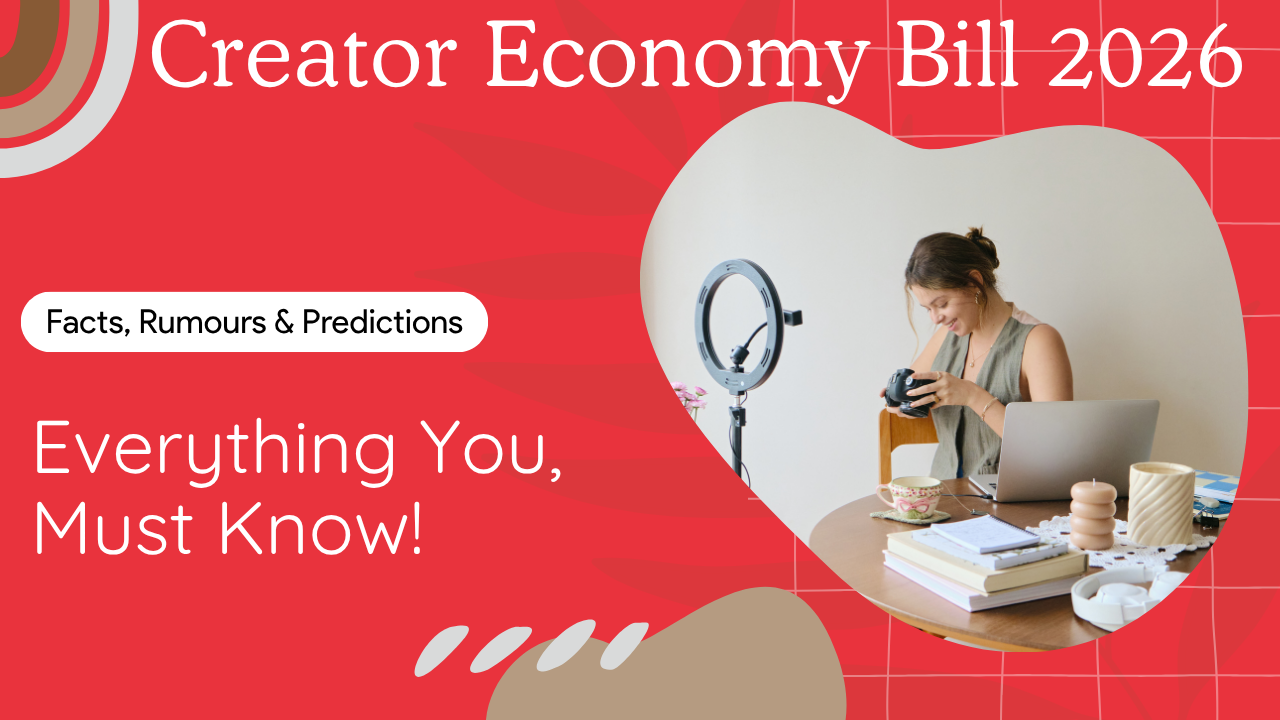
India’s creator economy is already the size of a serious industry. What it still lacks is a law that treats it like one. A viral claim that a “National Creator Economy Bill 2026” was passed by the Rajya Sabha on April 14, 2026, has been widely circulated on social media. Ping Network reviewed official sources, including PIB, PRS India, and Sansad records, and found no evidence of such a bill. However, the conversation itself is interesting and worth paying attention to. While this specific bill may not exist as of today, the ideas being discussed reflect very real shifts already underway from platform-level policy changes and stricter disclosure norms to increasing focus on taxation, AI transparency, and creator accountability. So we thought to shed some light on some verified trends, credible industry data, and visible policy gaps to explore what regulation in the creator economy could realistically look like and what creators should be paying attention to right now.
The Scale Is Real The System Isn’t
India’s creator economy is no longer an emerging trend; it is already operating at a meaningful scale. Estimates suggest that India has tens of millions of content creators, with roughly 1.5–2 million earning professionally in some capacity. The influencer marketing industry alone crossed ₹2,000+ crore (~$250–270 million) in 2024, and continues to grow at an estimated 20–25% annually, according to multiple industry reports. At the same time, government-backed and industry studies point toward a sharp rise in demand for creative talent, especially across animation, gaming, digital media, and content production through the end of the decade. By every indicator, the creator economy is contributing to employment, consumption, and digital exports. And yet, beneath this growth story lies a structural gap.
Most creators in India still operate within an informal ecosystem, without access to:
- structured social security
- standardised contracts
- institutional financing
- or formal recognition as a distinct professional category
In effect, one of India’s fastest-growing sectors is being built without a parallel policy framework to support it.
What the Government Has Actually Done For Creators
So far, policy direction has largely focused on enabling the ecosystem not formalising it.
Recent initiatives have emphasised:
- expansion of AVGC (Animation, VFX, Gaming, Comics) skilling infrastructure
- increasing recognition of digital media within the broader “Orange Economy” narrative
- early-stage efforts to strengthen platform–institution collaboration
- investment in talent development and creative capacity building
These are important supply-side interventions that strengthen the pipeline. But they do not fully address the realities of working creators already operating within the system.
The Missing Layer: Policy for Working Creators
This is where the gap becomes more visible. Creators today sit in a grey zone, economically relevant, but structurally undefined.
- There is no clear legal identity
Creators are still treated as informal, self-employed individuals rather than a recognised professional category within policy frameworks. - Access to welfare and social security remains limited
There are no structured systems tailored to creators for health coverage, retirement planning, or income protection. - Regulation is evolving — but protection is not keeping pace
Disclosure norms, platform policies, and compliance expectations are increasing, but without parallel clarity or safeguards. - There is a capital access gap
Financial systems still do not recognise content IP, audience equity, or recurring digital income as credible collateral — limiting creators’ ability to access credit or scale sustainably.
What a Real Creator Economy Policy Could Look Like?
If regulation does take shape in the future, it will need to move beyond enforcement and toward enablement. A meaningful framework would likely include:
- Legal recognition
A formal definition of “professional creator” within economic policy - Welfare architecture
Portable systems for insurance, healthcare, and long-term financial security - Proportionate regulation
Compliance frameworks that scale with creator size and revenue - Capital access mechanisms
Recognition of IP, audience value, and predictable income streams - Distributed infrastructure
Regional ecosystems that expand access beyond metro-centric creator hubs
The Core Tension
Creators are increasingly positioned as economic drivers — but continue to operate within unclear and fragmented systems. We AT The Ping Network believe India’s creator economy has achieved scale, but what it lacks now is structure. Because infrastructure without rights is simply capacity without security.
Sources & Basis
This analysis draws on public domain data and policy signals, including Union Budget announcements, industry estimates, the Ikigai Law (2025) report, Economic Survey references, and broader ecosystem trends.