Thinking of Starting YouTube? Why 2026 Is Different from the Lockdown Growth Phase
There has been a lot of conversation lately around a possible lockdown. While it remains a rumour, the behavioural pattern it has triggered is very real. Social media is already filled with relatable reels of people joking about finally becoming content creators and not missing this “opportunity.” We have seen this before. During COVID, a large number of underdog creators found visibility and built strong audiences. That phase created a perception that when life slows down, content creation becomes an easy entry point to growth.
But the context in 2026 is very different. Today, even if you get time, starting is not the advantage it once was. The advantage lies in how you start, how fast you learn, and how well you adapt. Because, unlike 2020, the ecosystem is no longer forgiving. It is structured, competitive, and performance-driven from day one. So if this moment pushes you to begin, the approach has to be deliberate—not reactive.
How to Choose the Right Niche in 2026 (Search Demand vs Passion)
Most beginners believe that choosing a niche is about following passion.In reality, niche selection is about positioning yourself in an existing demand system. Passion helps you sustain effort, but it does not automatically create viewership. Viewership comes from alignment with what people are already searching for, struggling with, or consuming repeatedly. This is why the most effective starting point is not “What do I like?” but: “Where does my capability intersect with existing audience demand?”
Search behaviour is one of the clearest indicators of this demand. It reflects what people are actively trying to solve or learn. When a creator aligns with this, they are not pushing content into the system—they are entering conversations that already exist.
At the same time, capability matters equally. A niche that has demand but cannot be consistently executed becomes unsustainable. The goal is not to pick something trendy, but something repeatable. For example, a creator who chooses “quick, practical home cooking” has far more content depth and frequency potential than someone starting broadly with “food videos.” The difference is not creativity—it is clarity. This clarity at the beginning reduces confusion later.
Your First 10 YouTube Videos Strategy (What Beginners Should Post First)
One of the biggest mistakes new creators make is treating their early videos as final output. In reality, your first 10 videos are not about performance. They are about understanding how the platform and audience respond to you. Most creators either overthink these videos or treat them casually. Both approaches slow down growth. What works better is treating these uploads as a structured learning phase. When you create content around search-driven topics, you start understanding how discoverability works. You see what kind of queries bring people in, how your content ranks, and whether your topic selection aligns with actual demand. When you create content around current conversations or trends, you learn something different—how timing, relatability, and packaging influence performance. You begin to understand what makes someone stop scrolling and engage.
This combination gives you a much clearer picture of:
- Why someone clicked
- Why they stayed (or didn’t)
- And what made the content worth watching
Without this phase, creators operate on assumptions. With this phase, creators start operating on signals. And in 2026, growth comes from reading signals correctly.
Do You Need Expensive Equipment to Start YouTube? (What Actually Matters)
A common delay in starting comes from the belief that better equipment leads to better results. This is one of the most persistent myths in content creation Production quality does matter, but not at the starting stage. What matters more is whether the viewer immediately understands what they are getting from your content, and whether it is delivered clearly.
A basic phone is sufficient to begin. Clear audio ensures the message is understood. Simple lighting and framing ensure the content is watchable. Beyond that, the marginal gain from better equipment is far lower than the gain from better clarity. In fact, many creators with strong setups struggle because the content itself lacks direction or structure. Early growth is not limited by production. It is limited by communication and relevance. The faster a creator realises this, the faster they start improving what actually matters.
Common Beginner Mistakes on YouTube That Slow Growth
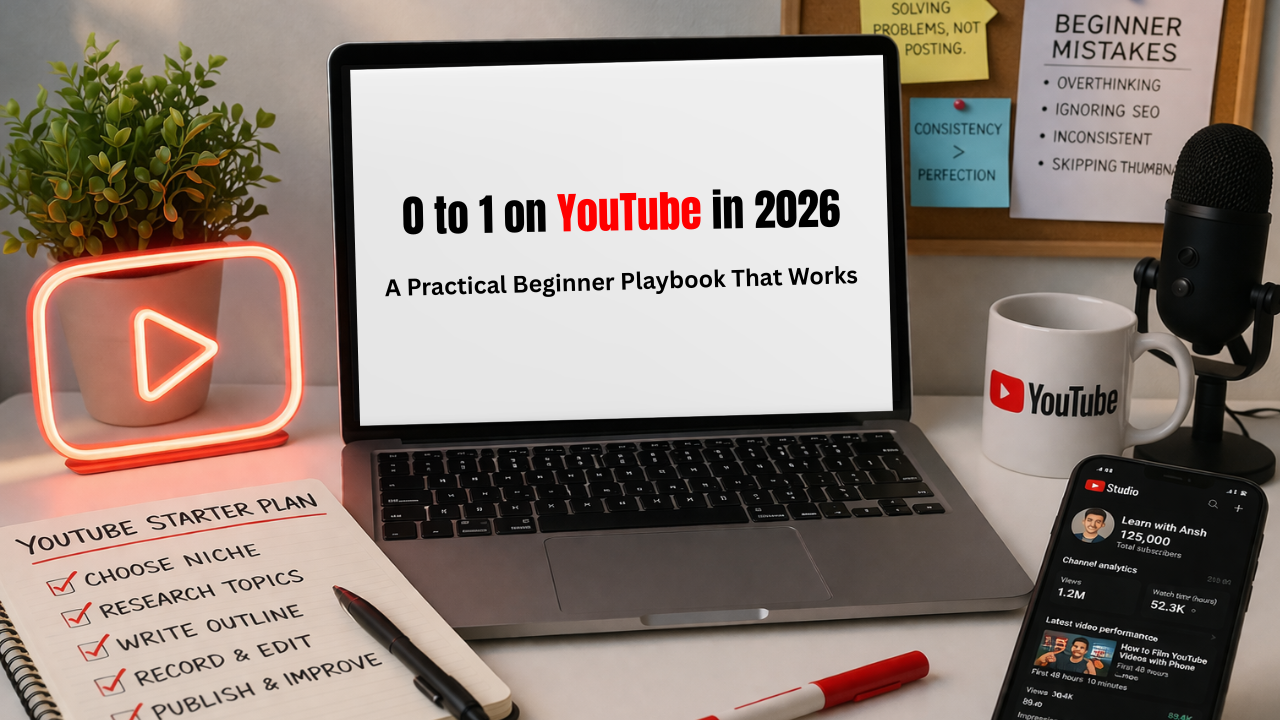
Starting is rarely the hardest part. Continuation is. The first major slowdown comes from overthinking. Many creators delay publishing because they want every video to be perfect. But perfection is not a starting requirement—it is a byproduct of iteration. Without publishing, there is no feedback loop. Without feedback, there is no improvement.
The second major gap is underestimating packaging. Titles and thumbnails are often treated as an afterthought, when in reality they determine whether the content gets a chance at all. A well-made video that is poorly presented struggles to get clicks. And without clicks, the system has no reason to test or push the content further. These are not advanced growth tactics. They are foundational. Ignoring them creates friction. Fixing them creates momentum.
How Successful Creators Think: Learning Faster vs Posting More
The biggest advantage a new creator has today is not creativity or resources—it is adaptability. Every upload provides feedback. Where viewers drop off, what they respond to, what drives clicks, and what holds attention. These are not just metrics—they are signals that guide improvement. The creators who grow fastest are not the ones who get everything right initially. They are the ones who learn faster than others. This requires a shift in mindset. Instead of asking, “Did this video perform?”, the better question is: “What did this video teach me?”
Over time, these learnings compound. Content improves. Decisions become sharper. Growth becomes more predictable. This is what separates random effort from structured progress.
Final Takeaway: How to Grow on YouTube in 2026
Whether a lockdown happens or not is secondary. What matters is that moments like these often push people to finally start. But starting in 2026 is not about catching an opportunity—it is about building a process. If you do get the time and intent to begin, your advantage will not come from timing. It will come from how quickly you move from confusion to clarity. Start without overthinking. Learn from every upload. Refine continuously. Because today, growth is not given to creators who start early. It is built by creators who learn and adapt consistently.
How Ping Helps New Creators Grow Faster
As the best MCN in India, We at Ping Network, work with creators at the 0–1 stage to remove guesswork and bring clarity to what actually works. From identifying the right content direction to structuring videos around audience intent and retention, the focus is on building a system, not just posting content.
If you’re starting your journey or trying to get initial traction, the right guidance early on can significantly reduce trial and error and accelerate your growth. Explore more insights on our website or connect with us to start building your channel the right way.