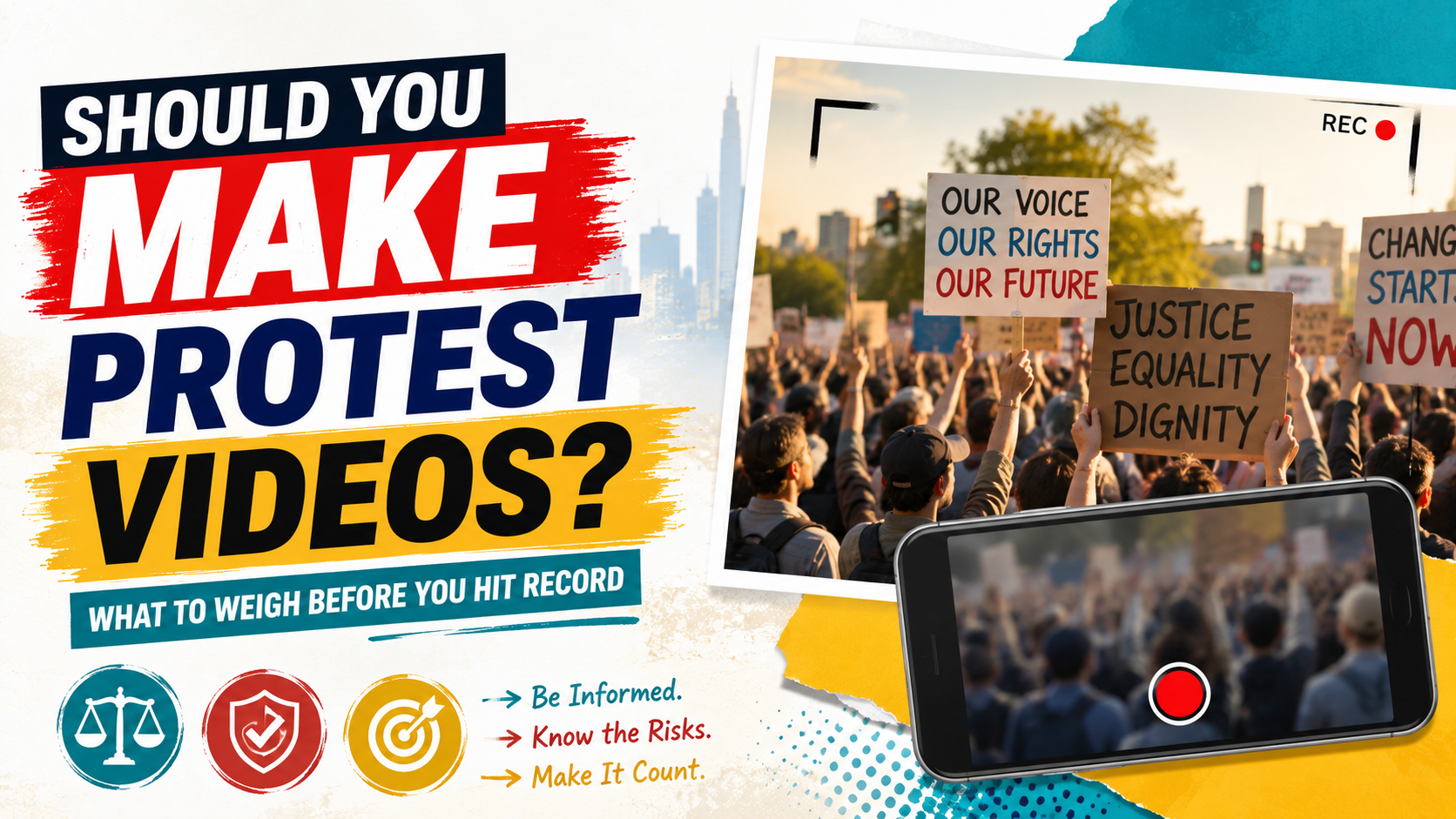
The Answer Is Not Yes or No. It Depends on What You Are Walking Into.
Protests, marches, and public demonstrations have become a recurring subject for creators not just news channels, but vloggers, commentators, and citizen journalists who happen to be nearby with a camera.
The instinct is understandable. This is footage that feels urgent, real, and shareable in a way scripted content rarely is. But before that footage becomes a video on your channel, it is worth pausing on a question most creators skip: what exactly are you making, and what are you signing up for once you upload it. This is not a piece telling you to avoid the subject. It is a piece asking you to be clear-eyed about it first.
Documentation, Commentary, or Content: Know Which One You Are Making
A protest video can be three very different things wearing the same format. It can be documentation, a record of what happened, filmed with minimal narration and no added opinion. It can be commentary your analysis or position layered over the footage. Or it can be content footage shaped primarily to perform well, with pacing, music, and framing chosen for engagement rather than accuracy. Each of these carries a different level of responsibility, and audiences increasingly notice when a creator has blurred the three without realising it. Deciding which one you intend to make, before you film, changes almost every choice that follows what you show, what you leave out, and how you caption it.
How Each Platform Actually Treats Protest Footage
Platforms do not treat protest footage the same way they treat most other content, even when it is filmed responsibly. The rules differ enough by platform that clearing one is no guarantee of clearing another, so it is worth looking at them one at a time.
YouTube
YouTube’s policies on graphic content, hate speech, and what it categorises as sensitive or controversial events apply a stricter, more automated layer of review to this kind of footage than to almost anything else a general creator posts. A video can be entirely factual and still get age- restricted, limited in reach, or sent for manual review — not because it broke a rule, but because the subject matter itself triggers additional scrutiny.
Instagram and Facebook
Meta runs a similar layer across both platforms, built on its own rules for violence and
incitement, graphic content, and coordinated harm, applied to protest footage specifically rather than only to obviously violent clips. Distribution also splits by format — a Reel, a feed post, and a Story can each get a different reach outcome for the same clip, and a Facebook share of a video does not automatically inherit whatever review outcome the original Instagram post received.
TikTok
TikTok has been tightening its enforcement specifically around civic events and crises, applying tougher checks during elections and crises that can flag or remove misleading or unverified claims faster than on routine content. Two things are worth flagging for a Ping-managed channel specifically: TikTok has remained fully banned for consumer use in India since 2020, so it is not a realistic distribution channel for a domestically focused Indian creator regardless of content policy. It only becomes relevant if your protest content is aimed at a diaspora or international audience through a foreign-registered presence, and even then, the same civic- event scrutiny applies.
Is Snapchat Worth Considering?
Rarely as a primary platform for this kind of content, though not entirely irrelevant. Snapchat’s design is deliberately friends-first and private by default, so organic protest footage does not spread the way it can on an open feed. Public discovery lives mainly in Map and Spotlight, which do surface breaking-news content, but recommendation there is curated and held to a higher bar than a standard post — Snap’s own guidelines note that newsworthy, factual content tied to a matter of political or social value gets more leeway, but reach still depends on already being an established creator or media partner rather than any random upload. For most Ping-managed channels, Snapchat is a secondary distribution point at best for this content type, not a starting point.
What About X (Twitter)?
Worth a brief mention even though it sits outside video-first monetisation strategy. X remains the platform where protest content circulates fastest and gets the least early friction, which is exactly why footage often surfaces there first before a creator repurposes it for YouTube, Instagram, or Facebook. It carries the same underlying legal and safety risks discussed below — the platform’s speed does not reduce your exposure.
The Real Risk Is Rarely the Video. It Is What Happens Around It
The footage itself is usually the smaller concern. The larger one is what surrounds it: filming identifiable individuals without consent in a legally ambiguous public setting, capturing law enforcement action in ways that can be selectively read out of context, or being present at an event that turns unpredictable partway through filming. Laws around filming in public during unrest also vary significantly by location, and “I was just filming” is not always a complete legal answer.
There is also a channel-level risk that is easy to underestimate. Once your channel is associated with a specific protest or political moment, that association does not stay contained to a single video. It becomes part of how your channel is read going forward, by your audience, by potential sponsors, and sometimes by people who disagree with what you filmed, regardless of how neutrally you filmed it.
The Monetization Reality Nobody Tells You Upfront
Most creators find out the hard way: protest and civil unrest footage is frequently demonetised, even when it is calm, factual, and free of graphic content. This falls under how platforms handle “controversial issues and sensitive events” broadly, not a judgment on your specific video. If your channel relies on ad revenue, it is worth deciding in advance whether you are making this video for reach and relevance, and accepting that revenue may not follow.
A Simple Way to Decide
Before you upload, it helps to answer three questions honestly. What is this video actually for: documentation, commentary, or content and does your footage match that intent? Are you prepared for the legal, safety, and platform-policy exposure this specific event carries, given your location and what you filmed? And does this fit where you want your channel to be known for, six months from now, not just this week.
None of these questions have a universally right answer. But creators who ask them before filming make sharper, safer decisions than those who ask them after the upload is already live. If a video like this has already put your channel at risk a strike, a demonetization, or a takedown you believe was unfair that is exactly the kind of situation Ping Network’s Advocacy team works through daily. We will cover what to do when it goes wrong in the next piece in this series.
Click Here To Know The Do’s And Don’ts While Making Protest Content.