The Myth That Still Shapes How People See Creator Growth
There is a reason so many people still look back at the lockdown period and think, ” That was the best time to become a creator. It is not just nostalgia. During COVID, a large number of underdog creators found visibility, built communities, and in many cases turned content creation into a real profession. Even today, that phase is remembered as a golden window when ordinary people picked up a phone, started posting, and suddenly found an audience. But that memory has also created a dangerous myth. The myth is that if another uncertain or stay-at-home phase appears, creator growth will once again become easy. Simply showing up during a moment of disruption is enough to break through. That the market will somehow make space for everyone who starts creating. In 2026, that assumption is not just outdated, it is misleading.
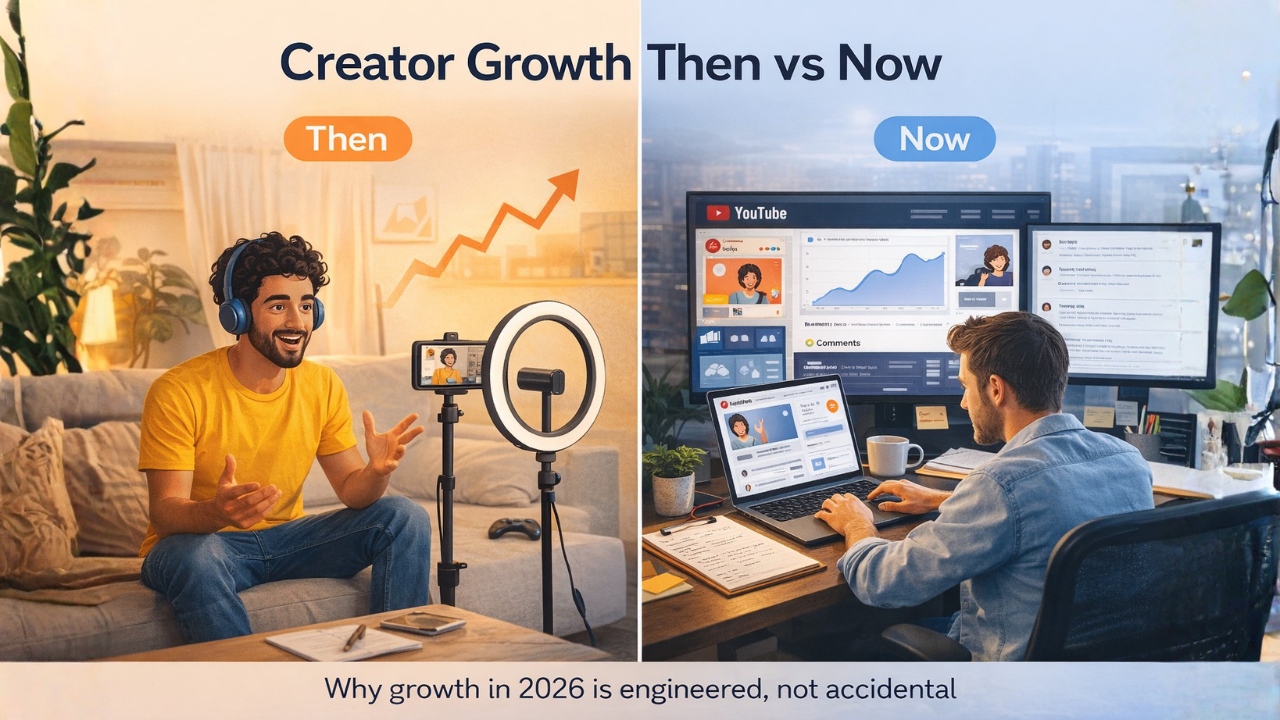
The reality is that the creator economy has changed fundamentally. Growth still happens, new creators still emerge, and underdogs can absolutely win. But the way growth happens today is very different from how it happened during lockdown. Back then, timing gave creators an unusual advantage. Today, growth is far more structured, competitive, and system-driven. It is no longer accidental. It is engineered. To understand what makes a creator grow now, it is important to first understand why so many creators grew then.
Why So Many Creators Grew During COVID
During COVID, audience behaviour shifted at scale. People were at home, screen time increased dramatically, and digital content became a primary source of entertainment, information, comfort, and routine. Viewers were not just consuming more content; they were consuming it more openly. They had more time to explore new formats, discover unfamiliar creators, and spend longer periods on platforms. This naturally created more opportunities for emerging voices to get noticed. At the same time, content supply had not yet reached the kind of saturation we see today. Yes, many people began posting during lockdown, but the overall ecosystem was still less crowded than it is now. Platform habits were evolving quickly, audiences were more forgiving, and creators could grow even while learning publicly. In many categories, consistency and relatability alone were enough to build traction. That does not mean creators who grew during that period did not work hard. Many of them did. But it does mean they were operating in an environment where the gap between audience demand and content supply was unusually favourable. More people were watching, fewer creators were fully optimised, and platforms were aggressively surfacing content to keep users engaged. That environment does not exist in the same way anymore.
Why the Old Playbook Does Not Work in 2026
In 2026, platforms are far more mature. Recommendation systems are more refined, audience expectations are sharper, and nearly every niche has become more crowded. Today, a creator is not only competing with others in the same category, but also with a massive volume of professionally packaged, strategically planned, and algorithm-aware content. Posting alone is no longer a differentiator. Presence is common. Precision is rare.
This is where many people misread the present through the lens of the past. They assume that if people begin spending more time online again, the same formula will repeat itself. But increased screen time alone does not guarantee opportunity. If anything, it raises the quality bar. Platforms now have more data, more creators to choose from, and better systems for identifying which content deserves distribution. The algorithm has become less about giving everyone a chance and more about rewarding content that proves it can hold attention, satisfy intent, and keep users within the platform ecosystem. That is why the old playbook of random posting, trend copying, or waiting for virality is much weaker today.
What Actually Works On YouTube In 2026
The first major shift is that content must be rooted in audience intent. This is one of the clearest differences between creator growth in the lockdown era and creator growth in 2026. Earlier, a creator could sometimes gain momentum through personality-led, spontaneous, or loosely structured content because people were in a discovery mode. Today, much of growth begins when a creator understands what the audience is actively looking for, feeling, or struggling with. Intent-based content performs because it meets people where they already are. It answers a question, solves a problem, simplifies a decision, or responds to a real behaviour pattern. In practical terms, that means creators need to stop asking only, “What do I want to post?” and start asking, “Why would someone choose to watch this right now?”
This applies across niches. A food creator may see stronger performance by aligning recipes with actual household concerns, such as budget cooking, quick meals, storage, or appliance-based alternatives. A finance creator may grow faster by addressing urgent money behaviours rather than speaking in broad motivational language. A lifestyle creator may perform better by tapping into routines, anxiety points, or seasonal shifts instead of posting generic inspiration. The common thread is relevance. Random content can still get views. But relevance builds repeatability.
Why Retention-First Storytelling Matters On YouTube
The second major shift is that growth today depends heavily on retention-first storytelling. Many creators still believe that success comes from posting frequently enough, but frequency without watchability does not create sustainable growth. A creator may get an impression, maybe even a click, but if the content does not hold attention, the system has little reason to keep recommending it.
This is why storytelling has become a performance factor, not just a creative one. Retention-first storytelling means understanding that every video is a journey. The title and thumbnail create expectation. The opening seconds must justify the click. The middle must keep delivering value without losing momentum. The ending should leave the viewer satisfied, curious, or motivated to continue with more content. This is not limited to cinematic creators or polished productions. Even a simple talking-head video needs structure. Even an educational video needs pacing. Even a recipe needs narrative movement. Viewers do not stay because a creator uploaded. They stay because the creator gave them a reason to.
That reason could be suspense, clarity, transformation, emotional connection, or practical usefulness. But it must exist. In 2026, content that gets recommended is content that consistently proves it can maintain viewer interest. This is why creators who focus only on posting more often without improving their storytelling often feel stuck. They are working harder, but not becoming more watchable.
Why Multi-Format Strategy Has Become Essential In 2026
The third major shift is format strategy. During lockdown, a creator could sometimes build meaningful traction through a single format because audience habits were less fragmented and platform behaviour was different. In 2026, format matters not just for content delivery, but for audience funnelling.
A smart creator today understands the role of different content types. Shorts can create reach, fast discovery, and high-frequency touchpoints. Longform builds depth, trust, stronger watch time, and a deeper audience relationship. Community interaction and ecosystem thinking help maintain continuity between uploads. None of these formats should be seen in isolation.
One of the biggest mistakes creators make is treating Shorts and longform as separate identities. In reality, the strongest growth often comes when they support each other. A Short can introduce a creator to a new viewer. A longform video can convert that curiosity into trust. A consistent content ecosystem can then turn that viewer into a returning audience member. That is where growth becomes more stable. The keyword here is synergy. Shorts without longform depth can create shallow visibility. Longform without discoverability can limit reach.
Random experimentation without a format strategy creates scattered results. The creators who grow today are usually not those doing the most, but those connecting each format to a clear purpose.
Why “Just Start Posting” Is No Longer Enough
This is also why the phrase “just start posting” is incomplete advice in 2026. Starting matters, yes. But growth does not come merely from participation. It comes from building a content system that works. A system where topics are chosen with audience intent in mind. A system where videos are structured to retain attention. A system where formats are used strategically instead of casually.
And most importantly, a system where every upload teaches the creator something measurable. This is the real difference between then and now. In the lockdown era, many creators benefited from an open field. In 2026, creators must create their own advantage. That advantage comes from understanding behaviour better than others, packaging content more effectively than others, and staying consistent with purpose rather than noise.
The Real Takeaway
None of this should discourage new creators. In fact, it should do the opposite. Because if growth were still based mostly on luck, timing, or easy virality, then long-term success would be far less controllable. The good news is that growth today is more demanding, but it is also more learnable. A creator who understands strategy has a much better chance of building something durable than one who simply waits for the perfect moment.
That is the real takeaway. Lockdown may have made creation feel accessible. But 2026 demands intention. The creators who will grow now are not necessarily the loudest, earliest, or most frequent. They are the ones who understand that modern growth is built through relevance, retention, and format intelligence.
The era of accidental creator success is fading. The era of engineered creator growth is already here.
How Ping Network Helps Creators
At Ping Network, this is exactly where we help creators and channels think better, not just post more. From content direction to platform-aware growth strategy, the goal is to build systems that last beyond momentary spikes. Because in 2026, staying relevant is not about chasing opportunity.
It is about knowing how to convert it into sustainable growth.