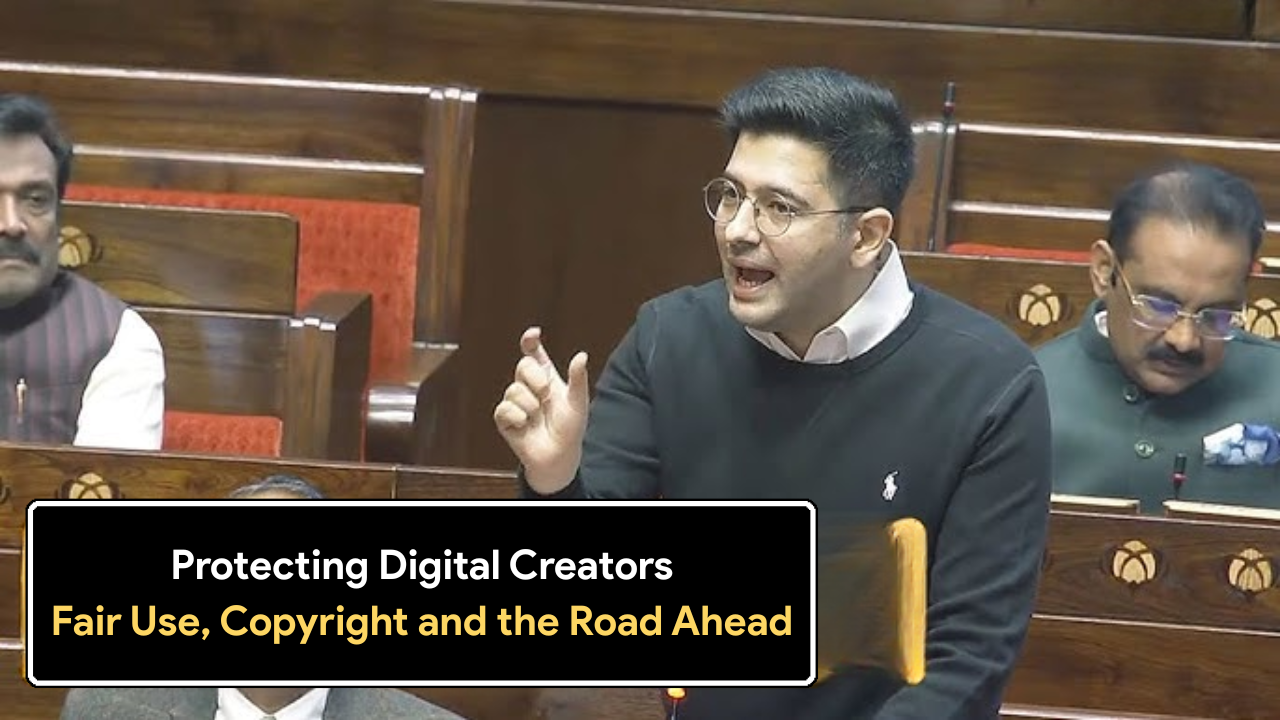
India’s creator economy has matured rapidly. Today, a YouTube channel, music catalogue, or digital video library is not just “content” — it is a livelihood, a business asset, and often the result of years of consistent effort. Yet, the legal framework and platform-level safeguards meant to protect creators have struggled to keep pace with this growth. Recently, during proceedings in Parliament, Raghav Chadha raised an important concern — the growing number of creators facing account bans, takedowns, or monetisation loss for using extremely small or incidental portions of copyrighted material, often without malicious intent. His intervention has reopened a much-needed conversation around how copyright enforcement is being applied in practice on digital platforms.
What Was Highlighted in Parliament (In Simple Terms)
The core issue raised was not about defending piracy, but about disproportionate punishment. Creators today can face: Channel strikes or bans Video takedowns, Revenue blocks, even when the usage involves:
- A few seconds of background audio
- A brief visual clip used for explanation, commentary, or critique
- Incidental music captured unintentionally during vlogs or live recordings
The concern is clear: small, non-substitutive usage is increasingly being treated the same way as full-scale infringement — and that imbalance puts creator livelihoods at risk
How Copyright Tools Are Being Misused Today
Copyright protection tools such as Content ID are essential to protect original work. However, their misuse or over-application has become increasingly common. Some real-world patterns we see include:
1. Claims on Negligible or Accidental Usage
Creators receiving strikes for: Background music is faintly audible in public spaces. TV screens are visible for a few seconds in lifestyle or vlog content. These uses rarely replace or compete with the original work, yet still trigger enforcement.
2. Automated Claims Without Human Review
Many claims are fully automated Context-agnostic Lacking human verification. As a result, educational, review, parody, or commentary content is often penalised unfairly.
3. False or Opportunistic Ownership Claims
In some cases Rights are claimed without legitimate ownership. Public-domain or properly licensed material is flagged.d Disputes become prolonged and opaque. This drains creators emotionally and financially, and creates a chilling effect where creators begin to self-censor out of fear.
Why This Is a Serious Problem for the Creator Ecosystem
For large studios, a wrongful claim may be an inconvenience. For independent creators, it can mean:
- Sudden income loss
- Channel termination
- Years of work were raised overnight.
When enforcement lacks proportionality, copyright stops being a protection mechanism and starts functioning like a blunt instrument. This is precisely why voices like Raghav Chadha’s matter — they signal that policymakers are beginning to recognise the ground-level realities faced by digital creators.
How PING MCN Uses Copyright Tools Responsibly
At PING MCN, we work closely with creators, labels, and rights holders. We believe copyright enforcement must be fair, transparent, and accountable.
Our approach is guided by three core principles:
1. Claims Only Where Legitimate Rights Exist
We ensure Proper documentation before onboarding content, clear ownership validation, and no speculative or bulk claims. Human intervention before enforcement. If rights are unclear, we do not claim.
2. Context-Aware Enforcement
We actively avoid claiming incidental or background usage, penalising commentary, review, or educational formats, and over-enforcement that erodes creator trust. Protection should never come at the cost of creativity.
3. Dispute Resolution Over Punishment
When conflicts arise, our priority is Dialogue, Evidence-based resolution, and Minimising disruption to creator earnings. The goal is rights protection, not creator suppression.
Looking Ahead : The Bigger Picture, Protection With Proportion
Copyright laws and tools are essential, but how they are applied matters just as much as why they exist. The conversation initiated by Raghav Chadha in Parliament reflects a growing realisation:
- Digital creators need clarity, not fear
- Enforcement must be proportionate, not automated punishment
- Innovation thrives only when creators feel secure
At PING MCN, we strongly support any move that brings balance between rights holders and creators, and we remain committed to using copyright tools ethically, responsibly, and transparently. Raghav Chadha’s call to amend the Copyright Act is an important signal that India is beginning to take its digital creators seriously at a policy level.
Discover how PING MCN empowers creators and rights holders with transparent, compliant Content ID and rights-management solutions.
Contact us now: https://www.pingnetwork.in/